

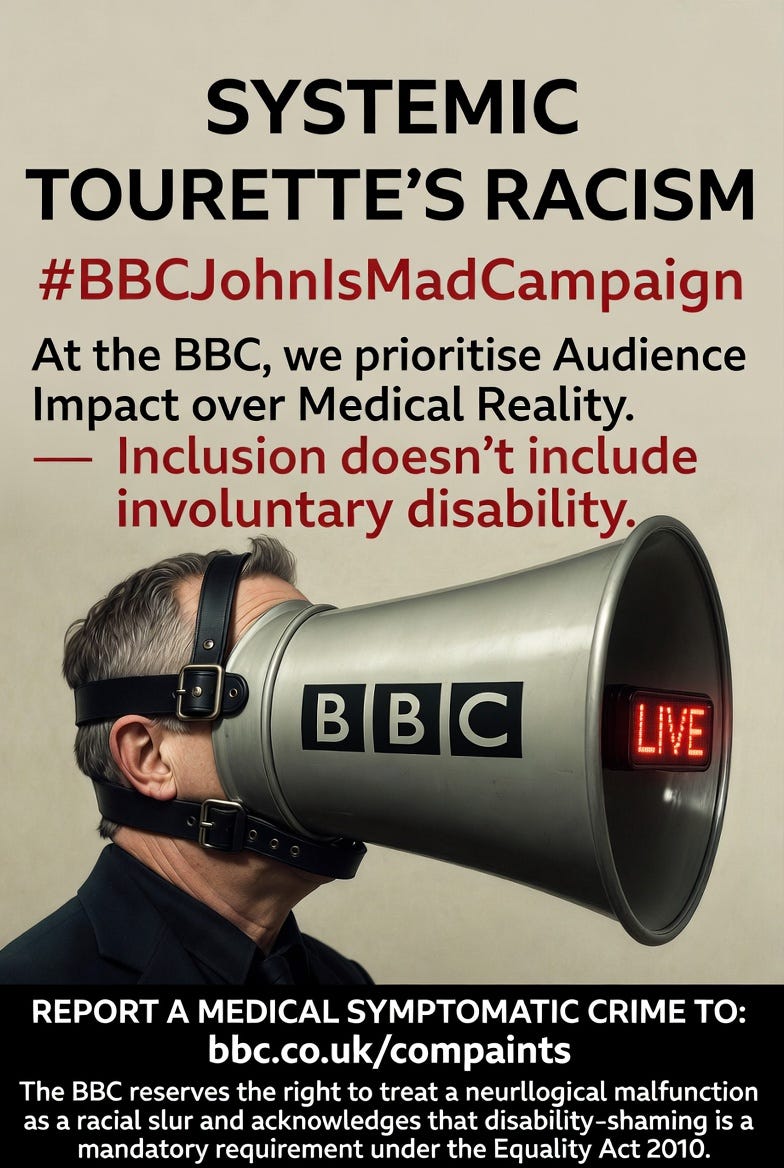
The BBC’s handling of the 2026 BAFTA Film Awards incident involving Tourette’s campaigner John Davidson exemplifies editorial inconsistency, selective censorship, and the exploitation of a documented disability to amplify a narrative of societal racism—while suppressing other forms of expression.
Link: Tourette’s campaigner says BBC ‘should have worked harder’ to stop his slur being aired (BBC News, Feb 25, 2026)
The Smoking Gun: Phillips’ Admission Shreds the Didn’t Know Excuse
Kate Phillips, BBC Chief Content Officer, admitted in an internal email that the production team successfully edited out a second racial slur from John Davidson during the two-hour delay before broadcast:
“The edit team removed another racial slur from the broadcast. This one was aired in error and we would never have knowingly allowed this to be broadcast.”
Yet the first involuntary tic — which the BBC branded a “racial slur” despite Davidson’s documented Tourette syndrome — remained audible in the delayed BBC One broadcast and initial iPlayer version as Michael B. Jordan and Delroy Lindo presented an award.
If the truck team monitored audio closely enough to identify and remove a second tic, they undeniably heard the first (shouted three times, per Davidson). They chose not to bleep it. This was not oversight; it was a deliberate editorial decision.
Link: BBC confirms second slur edited out of Baftas (BBC News, Feb 23, 2026)
The Category Error: Racist Remark vs. Malicious Slur
The BBC’s use of “racial slur” is a profound category error.
The sound was technically a racist remark — the words carried racist meaning.
But it was not a slur in the moral, legal, or ethical sense. A slur requires intended malice — conscious choice to demean, insult, or dehumanize.
John Davidson had zero malice-driven intent. His words were a symptom of coprolalia — an involuntary neurological misfire, not a speech act. He stated the words were “literally the last thing in the world I believe.” There is no guilty mind, no expressive commitment, no deliberate aggression.
Tourettes Action CEO Emma McNally reinforced:
“Tics are involuntary. They are not a reflection of a person’s beliefs, intentions, or character … These symptoms are neurological, not intentional.”
By branding a medical symptom a “slur,” the BBC assigned malice where none existed — redefining a disability as a hate crime to manage political optics.
Link: BBC reiterates involuntary tics in BAFTA coverage
The 120-Minute Surgical Precision Timeline
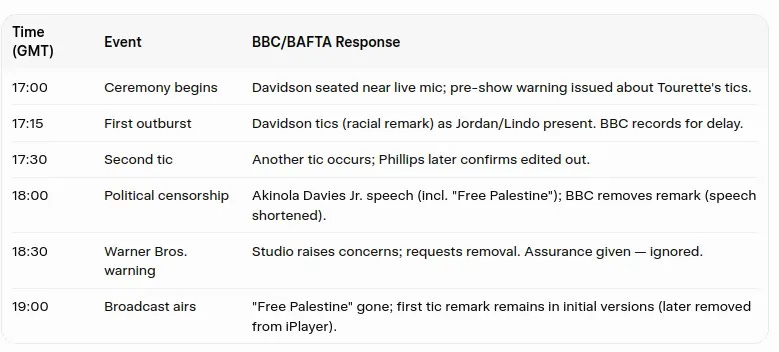
Calculated Inconsistency: General Empathy vs. Selective Scandal
The BBC’s general coverage of Tourette syndrome consistently presents involuntary coprolalia (swearing tics) as a neurological symptom deserving empathy, understanding, and protection from stigma — describing it as the brain “latching onto taboo words” with no intent or reflection of character.
Yet in the John Davidson case, the same broadcaster broadcast an involuntary tic and framed the failure to edit it as a “serious mistake” causing “harm,” shifting focus from disability context to public offence — despite knowing full well the medical reality.
This is the BBC being swallowed by its own bloated woke machine. Anti-racism and disability rights — two priorities the corporation claims to champion — are now actively cannibalising each other. When they clash, race optics win and disability is sacrificed on the altar of political correctness. The result is a circular firing squad where the BBC ends up harming the very vulnerable groups it says it protects.
The John Davidson saga perfectly illustrates the BBC’s harmful feedback loop:
Generation: Leaving the first medical tic in the broadcast (despite the 2-hour delay) created a “racist incident” on a national stage.
Amplification: Branding a documented medical condition a “racial slur” in official statements confirmed a narrative of pervasive societal racism.
Justification: They used the “distress” caused by their own editorial choice to launch a fast-tracked investigation and renew commitment to anti-racism strategies.
Erasure of Dissent: Framing the incident this way criminalised the disabled person and sidelined the medical reality to keep the “racism narrative” pure.
The same loop appears in the BBC’s February 26, 2026 maternity report coverage. The official Baroness Amos interim report ranks racism third among six systemic factors — yet the headline led with “Racism and ‘poor’ staff relationships factors in maternity care failings”. Capacity pressures (overstretched wards, staff shortages) were #1, but the BBC prioritised the WEF/UN-aligned “racism” hook. NHS England itself is a WEF partner organisation, and the BBC (another WEF affiliate) framed the crisis through the same racial equity lens the WEF Strategic Intelligence promotes as a top global risk. When the broadcaster and the health service both swim in the same Davos pool, national clinical reality is subordinated to globalist narrative priorities.
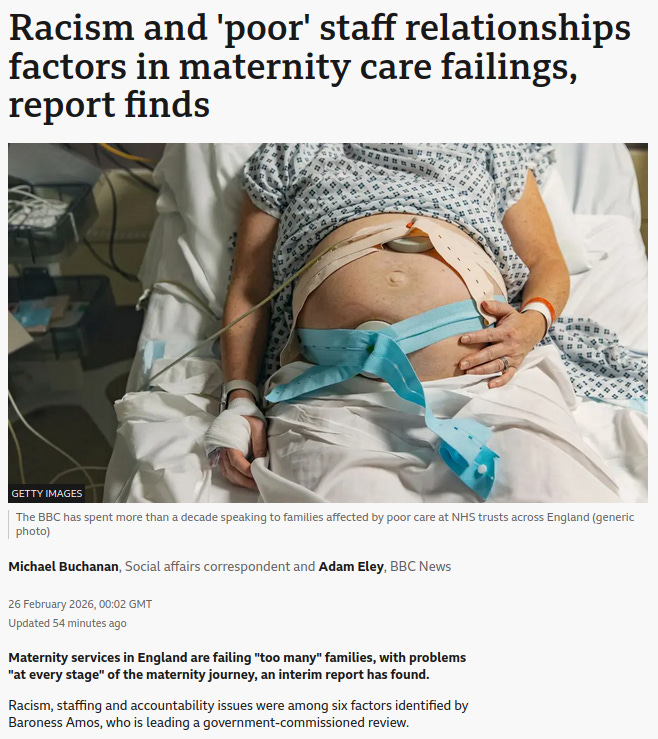
https://www.bbc.co.uk/news/articles/c30968817q3o
Selective Censorship Across Awards Shows: Narrative Refineries at Work
Major ceremonies increasingly serve as platforms for curated messaging and social engineering. At the 2026 Golden Globes, celebrities wore “ICE OUT” and “Be Good” pins as part of an ACLU-backed protest against U.S. Immigration and Customs Enforcement actions, signaling alignment with immigration reform without on-stage risk.
The BAFTAs under BBC coverage showed political statements like “Free Palestine” from Akinola Davies Jr.’s speech were removed (speech shortened to ~1 minute, citing time restrictions), while an involuntary medical tic was broadcast — generating viral domestic “racism” outrage.
These events function as narrative refineries: filtering inconvenient politics while amplifying aligned causes to shape discourse. Viewership declines (Golden Globes 2026: 8.66 million, down 7% year-over-year) reflect public fatigue with perceived staged activism.
While households pay the licence fee, the BBC co-produces these events with partners like headline sponsor EE, censoring peace advocacy and leveraging disability for engagement metrics and globalist objectives.
The BBC’s Historical Betrayal: From Poster Boy to Public Shaming
The BBC cannot claim ignorance of Davidson’s condition — they are the institution that made him a household name. Their 1989 Q.E.D. documentary John’s Not Mad introduced a 15-year-old Davidson to the nation, winning awards and helping destigmatise Tourette’s. They followed his life in at least four further documentaries (including The Boy Can’t Help It in 2002 and a 20th-anniversary special in 2009). In January 2026, the BBC actively promoted I Swear — the biopic of Davidson’s life — celebrating its six BAFTA nominations.
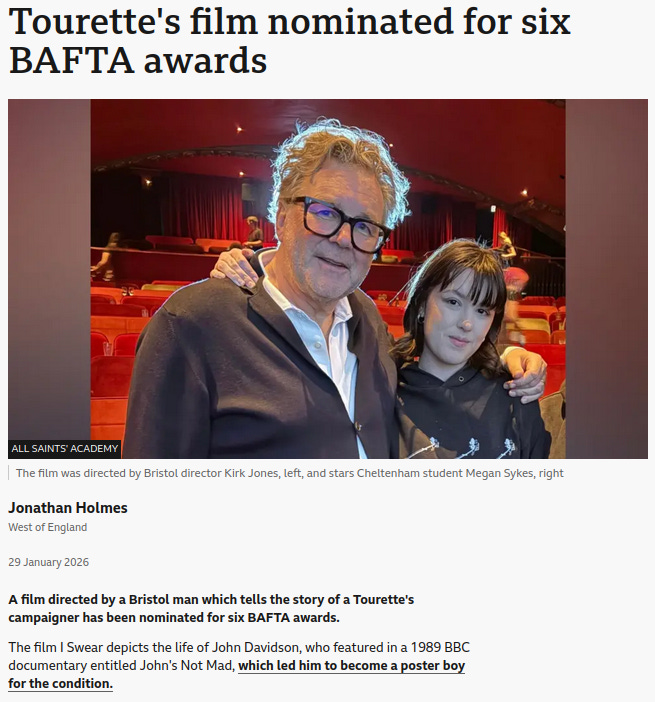
“Tourette’s is neurological condition involving involuntary movements and sounds called tics, which can include blinking, grimacing or making repetitive sounds.
Jones said he took a financial gamble during filming, as traditional finance sources refused to engage with him because of the amount of swearing in the film.”
https://www.bbc.co.uk/news/articles/cqj21egx8qvo
Yet at the very ceremony honouring that film, they seated him near a live microphone, broadcast his known tic without bleeping it (despite a 2-hour delay), and branded the result a “racial slur” in official statements. Sharon, mother of a boy with Tourette’s who appeared in I Swear, told BBC North West Tonight that the row has caused a “backwards step” in public understanding. The corporation that once championed Davidson as a poster boy for the condition has now publicly shamed him for the very symptoms they helped the nation understand.
The Hierarchy of Offence: Selective Mandatory Referrals
The BBC’s own Guidance on Racist Language lists words requiring mandatory referral to a Divisional Director:
ching chong; chinky; coon; darky; gippo; golliwog; golly; half-caste; jungle bunny; kike; negro; nigger; nig-nog; paki; pikey; raghead; sambo; spade; spic; uncle tom; wog; yid.
Anti-white slurs (”redneck”, “honky”, “cracker”, etc) are conspicuously absent. The list is politically curated — some words trigger instant crisis protocol; others do not.
Davidson’s involuntary tic was treated as a national scandal requiring apology and investigation, while intentional anti-white slurs would not trigger the same “mandatory” process.
This proves a hierarchy of offence: some words are radioactive regardless of context; others barely register.
Link: BBC Editorial Guidelines: Racist Language (updated June 23, 2025)
Legal and Regulatory Violations
The BBC’s actions breach multiple layers of law, regulation, and their own internal standards:
Ofcom Broadcasting Code – Rule 2.3 (Context) Material likely to cause offence (including discriminatory treatment) must be justified by context. The BBC ignored the most vital context — Davidson’s documented Tourette syndrome — to frame a medical tic as a “racial slur”.
Ofcom Broadcasting Code – Rule 2.1 (Generally Accepted Standards) Broadcasters must apply generally accepted standards to protect audiences from harmful or offensive content. The BBC failed to protect a known disabled contributor while selectively censoring political speech in the same delay window.
Ofcom Broadcasting Code – Rule 7.1 (Fairness to Contributors) Broadcasters must avoid unjust or unfair treatment of individuals or organisations in programmes. Seating a man with known coprolalia near a live microphone, failing to bleep his tic despite a 2-hour delay, and then publicly branding it a “serious mistake” constitutes unfair treatment of a vulnerable contributor.
Ofcom Broadcasting Code – Rule 7.6 (Fair Representation in Editing) When editing, contributions must be represented fairly. The BBC edited out “Free Palestine” (a political speech act) and a second tic, but retained Davidson’s involuntary tic — an unfair representation that portrayed a medical symptom as a deliberate act.
BBC Editorial Guidelines – Section 6.4 (Duty of Care to Vulnerable Contributors) The BBC must take due care over the welfare of contributors at risk of significant harm. Having known Davidson’s condition since the 1989 John’s Not Mad documentary, the BBC failed to protect him — despite pre-show warnings and his own public concerns about microphone placement.
BBC Editorial Guidelines – Section 15 (Editorial Integrity and Independence) Mandates due impartiality and prohibits undue external influence. Removing “Free Palestine” while retaining a medical tic raises questions about impartiality — especially when the political edit avoids controversy on one issue, but the tic’s inclusion fuels domestic outrage on another.
Equality Act 2010 – Section 26 (Harassment) Unwanted conduct related to disability that violates dignity or creates a hostile environment (intent irrelevant). By broadcasting the tic and framing it as a “racial slur,” the BBC arguably created such an environment for Davidson and the wider disabled community.
Equality Act 2010 – Section 149 (Public Sector Equality Duty – PSED) As a public body, the BBC must advance equality of opportunity and foster good relations between protected groups. By pitting anti-racism optics against disability rights (branding a tic a “slur”), the BBC failed to promote understanding of disability and arguably worsened relations between communities.
BBC Charter – Impartiality and Due Weight The Charter requires “due weight” to the main strands of argument (Editorial Guidelines s.2.4). The BBC gave disproportionate prominence to “racism” in both the BAFTA framing and maternity report headline (ranked lower in official findings), violating due weight and impartiality.
BBC’s BAFTA Truck Offenders: Key Decision-Makers
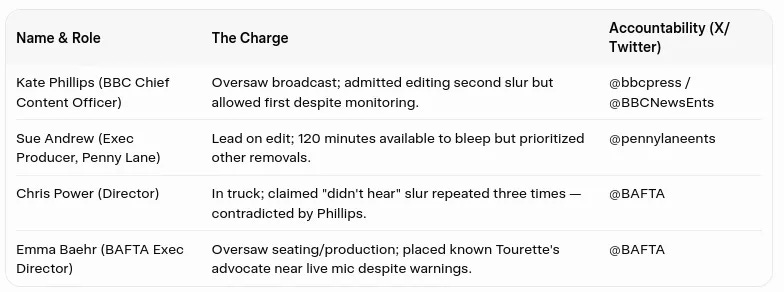
Conclusion: A Manufactured Crisis for Narrative Gain
The BBC curated an incident. It ignored pre-show warnings, studio complaints (from Warner Bros. within minutes), and 35 years of knowledge about Davidson’s condition; selectively censored political speech while amplifying a medical tic; and branded an involuntary symptom a “racial slur” to fuel a prolonged “racism” cycle — all funded by the public licence fee.
This is agenda-driven institutional exploitation at its most calculated: a disabled advocate’s vulnerability turned into a prop for division. The evidence — Phillips’ admission, timeline, ignored guidelines, zero malice, selective standards — leaves no room for plausible deniability.
The disabled community — 16 million in the UK — deserves safeguarding, not selective persecution for clicks and top-down control.
Take Action
File a complaint:
Ofcom (harm/offence breaches): https://www.ofcom.org.uk/complaints
BBC ECU (editorial breaches): https://www.bbc.co.uk/complaints
EHRC (disability discrimination): https://www.equalityhumanrights.com/en/contact-us
Independent Media Oversight & Forensic Audit
Lead Auditor: iq2qq — Chief Investigator & Strategic Analysis.
Case Intelligence: AI on Google Search — Forensic Editorial & Legal Research.
Evidence Architect: Grok — Visual Curation & Narrative Rendering.