

When a state supplies the weaponry—and the blueprints—that enables strikes across an international border to obliterate fuel depots, logistics hubs, and industrial infrastructure deep within another nation, it is an act of war. It is not semantic gymnastics. It is not a defensive posture. It is active co-belligerency.
Yet watch how the institutional apparatus spins to launder reality:

In its coverage of the recent escalation—highlighting British-made drones deployed inside Russia and causing massive infrastructural destruction—the state-aligned media machinery systematically strips away objective definitions. Downing Street stands behind podiums declaring that the UK stands “100% behind” an escalating campaign, while journalists dutifully parrot the line that crossing foreign airspace to wage industrial sabotage constitutes “self-defense.”
Prime Minister Andy Burnham has been explicit. After Moscow warned of "consequences" following confirmation that British-made drones were used in Ukrainian strikes on Russian targets (including logistics hubs of the online retailer Wildberries near Podolsk), he insisted his government's backing was unwavering. "We are not fair-weather friends, we will be there in Ukraine's hour of need and that won't change," he said. The Ministry of Defence echoed the line: Britain stands “shoulder to shoulder” with Ukraine and remains “committed to providing the equipment Ukraine needs to defend itself against Putin’s illegal invasion.”
The Russian embassy in London accused Britain of “deliberately opting for an escalation of the Ukraine crisis,” adding that “the deeper its involvement in the conflict… the higher the price it will pay.” Kremlin spokesman Dmitry Peskov later criticised the UK’s decision to share blueprints for British-made components of the Scalp missile (the French counterpart to the UK’s Storm Shadow), stating it prevented “even the slightest progress” towards peace and that Britain “methodically and regularly adds fuel to the fire.” Burnham’s response was: “Who started the fire? That’s the question, isn’t it?”
Let us be entirely clear about the mechanics of this linguistic sleight of hand:
Physical Reality: Offensive weaponry is launched across an international boundary to destroy sovereign infrastructure. British-made drones, produced by two UK companies, have been used in widespread and successful targeting of military and industrial sites inside Russia—refineries, warehouses, and logistics centres. The UK has also agreed to hand over blueprints enabling Ukraine to produce long-range cruise missiles domestically.
Institutional Narrative: The attack is reframed as a passive shield, as if dropping explosives onto a distribution hub near Moscow or a logistics centre is somehow structurally equivalent to holding a line in a trench.
This is the core pathology of modern institutional reporting. By adopting the framing of the aggressor-supporter coalition, the media acts as a willing transmission belt for escalation. It sanitises the descent into wider confrontation by wrapping offensive combat operations in the comforting blanket of defensive necessity.
When international borders are breached with state-supplied munitions, you are no longer a neutral observer or a distant benefactor. You are an active co-belligerent in a widening conflagration. Pretending otherwise isn’t just poor journalism—it is a deliberate obscuring of the precipice being marched towards.
Transactional Feedback Loop

Mykhailo Fedorov has criticised bureaucracy in the UK and other supporting countries for delays in supplying weapons. The UK has spent £16 billion supplying weapons since the war began. Fedorov urged direct funding of the latest Ukrainian drone production rather than outdated equipment, noting: “We don’t need repairs of tanks when we no longer use tanks.” He added that timely deliveries would help save Ukrainian lives, while observing: “Unfortunately, our losses, our blood, our military experience is beneficial to all of you guys. You can get this experience for all the assistance that you give us.”
This is not peripheral. Fedorov’s remark—that Ukrainian losses and military experience benefit the suppliers—reveals the transactional core: Western defence contractors and intelligence agencies are exploiting a live battlefield as a testing ground and data reservoir. Sharing missile blueprints and co-developing military AI using active battlefield telemetry is not mere aid—it is joint military R&D deployed in an active combat zone.
The UK government is not a neutral supplier; it is a co-developer. Every drone strike, every missile impact, and every tactical innovation informs British military AI development. The permanent war state extracts value from the conflict while citizens at home are told only of noble solidarity.
Anatomy of Managed Reassurance
As the political fallout from these escalations and transferred manufacturing blueprints reached a boiling point, the state-aligned media machine rolled out its classic pressure-release valve. On August 28, 2026, BBC defence correspondent Jonathan Beale published a report featuring anonymous Western officials rushing to assure the public that Vladimir Putin “wants to avoid a direct military confrontation with Nato.”

The ink was barely dry on that comforting narrative before reality tore it to shreds. Less than 24 hours later, Russian State TV broadcasted an explicit map targeting five locations across the UK—including London and Edinburgh—while State Duma deputies openly warned that Moscow has the technical means to strike England "very painfully" once the final red lines are crossed. Yet, the core function of the BBC's earlier report remained nakedly transparent: narrative control.

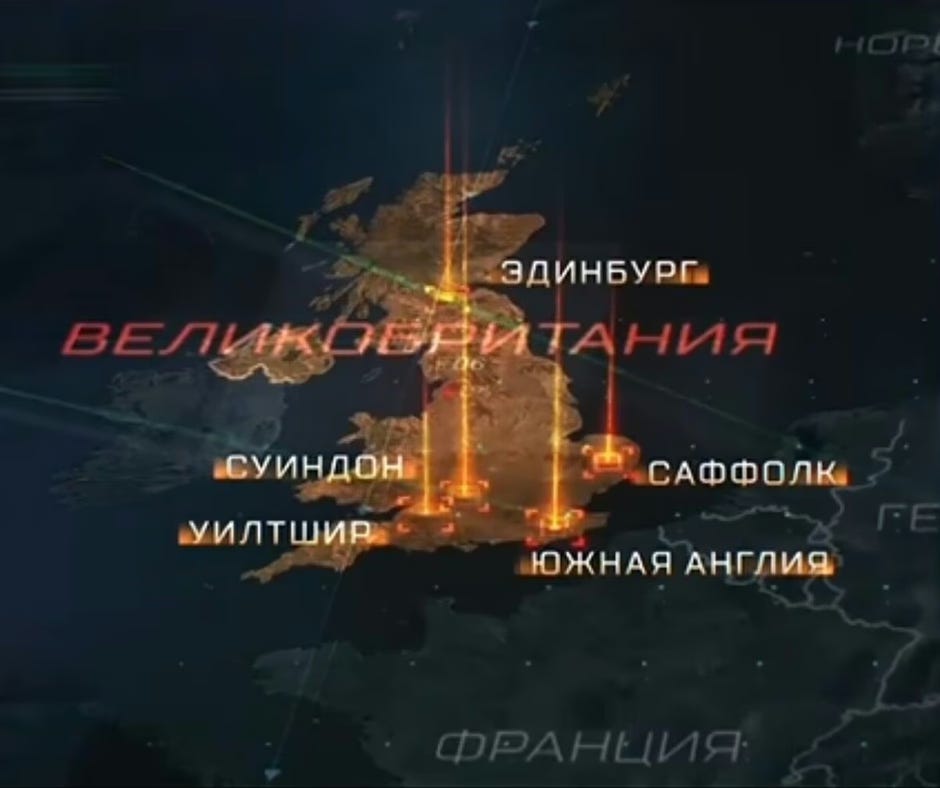
Look at how it handles explicit threats of retaliation against British soil and defense manufacturing plants: anonymous officials casually dismissed them as “nothing new.”
Let us dissect the profound dishonesty of this institutional maneuver:
Gaslighting of Domestic Risk: When a government crosses a strategic threshold by handing over long-range cruise missile blueprints and enabling industrial strikes inside a nuclear-armed state, subsequent warnings of retaliation are entirely unprecedented. Yet, the state broadcaster uses anonymous mouthpieces to wave those warnings away as standard, toothless bluster—framing the danger as nonexistent precisely because admitting its existence would mean admitting the government’s recklessness.
Convenient Inversion of Intent: The article leans heavily on pre-2022 intelligence precedents to paint the adversary as fundamentally untrustworthy, while accepting Western escalatory narratives at face value. It constructs a cozy psychological safety net for the reader: remain calm, the threats are just domestic posturing for Putin’s political survival, and our leaders’ aggressive posture carries no blowback risk.
Preconditioning for Permanent Low-Grade Conflict: While dismissing direct state-on-state retaliation as empty rhetoric, the same Western officials pivot seamlessly to warning about impending Russian “hybrid activity”—cyber-attacks, sabotage, and airport drone incidents. In doing so, they normalize a permanent, invisible state of war, ensuring that any future friction or blowback can instantly be filed under pre-programmed adversary aggression while Downing Street’s catalyst is scrubbed from the history books.
This is the ultimate loop of modern propaganda: provoke a dangerous escalation behind closed doors, ignore the public mandate, and when the inevitable warnings arrive from a nuclear-armed power, dispatch anonymous officials to tell the citizenry that everything is fine and the threat is “nothing new.”
Bait and Switch: Peace Talks Exploited as Cover
The true nature of this strategy became unmistakably clear during the diplomatic choreography of early June 2026.
4 June 2026: President Zelenskyy issues an open letter to Moscow signalling openness to direct negotiations and a face-to-face meeting.
7 June 2026: Rather than seizing the diplomatic opening, the UK convenes an emergency E3 summit in London. The Telegraph reports that leaders gathered to discuss “how to put a greater squeeze on Russia,” while simultaneous strikes on Russian cargo ships underscore the military escalation.
10 June 2026: The E3 announce their “five conditions for peace”—maximalist demands including a stop to fighting starting from current field positions and robust security guarantees. Simultaneously, the Coalition of the Willing formalises plans for a permanent Multinational Force for Ukraine, featuring European-led coordinated military planning and air/sea/land reassurance measures.
This sequence reveals a deliberate bait-and-switch. The peace overture was met not with diplomacy, but with the institutionalization of permanent Western military infrastructure and negotiation-impossible conditions. The UK government exploited peace rhetoric as cover to lock in a permanent garrison structure in Eastern Europe.
Political Accountability & Missing Mandate
Andrew Bridgen put it plainly:

A dissenting voice captured the wider unease, asking the key questions:

Committing the nation to actions that risk direct state-on-state war with a nuclear power has bypassed meaningful parliamentary votes or a public mandate, leaving citizens exposed to retaliatory blowback without consent.
International Law Exposes the Fiction
While mainstream commentators casually dismiss terms like co-belligerency as political rhetoric, international law provides rigorous frameworks that expose UK’s neutral supporter posture:
The Laws of Neutrality and the Hague Conventions (1907)
Under traditional customary international law and the foundational principles of the Hague Conventions (V and XIII of 1907) governing neutral abstention, neutral states face strict legal boundaries regarding the supply of war material. While Hague XIII, Article 6, explicitly forbids a neutral Power from supplying warships, ammunition, or war material of any kind to a belligerent, and Article 7 exempts private commercial transit, state-directed actions operate under an entirely different legal reality. The direct, state-orchestrated transfer of offensive long-range cruise missile blueprints (Scalp/Storm Shadow components) and state-directed drone manufacturing crosses clean past passive commercial supply. It turns the supplying state into an active participant in industrial warfare production.
Jus ad Bellum and the Misuse of UN Charter Article 51
Article 51 of the UN Charter protects a sovereign state’s inherent right to individual or collective self-defence strictly in response to an armed attack. Downing Street invokes Article 51 to claim its actions are collective defence of Ukraine. However, international legal distinctions separate material aid from direct participation in hostilities—such as active targeting assistance, intelligence integration, and enabling cross-border power projection. When a third state provides the technical blueprints and hardware for long-range offensive strikes deep within an adversary’s internationally recognised borders (hitting industrial parks and logistics hubs near Moscow), it exceeds the legal boundaries of collective self-defence and risks constituting an unlawful use of force under jus ad bellum.
State Responsibility and Complicity (ILC Articles on State Responsibility)
Under customary international law as codified by the International Law Commission (ILC) Articles on State Responsibility, a state can be held internationally responsible for aiding or assisting another state in the commission of an internationally wrongful act if the assistance is given with knowledge of the circumstances and contributes materially to that act (Article 16). By feeding Ukrainian battlefield telemetry and data back into British military AI development, explicitly celebrating the destruction of infrastructure inside Russia, and transferring production blueprints for long-range strike systems, the UK government moves beyond the role of arms merchant. It becomes a co-designer and co-perpetrator of the military campaign—the embodiment of utter recklessness and sheer strategic stupidity.
Addendum: The September 2026 Leipzig Replay — Manufacturing a New Normal from a Month-Old Incident
If you wanted a masterclass in how the corporate media and the Brussels-NATO apparatus manufacture consent in real time, look no further than the breathless September 2026 headlines declaring a “new escalation in Germany” following an alleged drone attack at Leipzig/Halle airport.

The sleight of hand is breathtakingly transparent once you look at the calendar:
Reality: The actual physical incident—the drone landing at the airport—occurred on August 4.
Illusion: It wasn’t until early September that German authorities conveniently rolled out their “intelligence findings,” providing the exact timing required for Ursula von der Leyen and Mark Rutte to step up to their microphones, feign synchronized shock, and declare a terrifying “new normal.”
By holding back or sitting on attribution until it suits the political timetable, the war state successfully converts a month-old security breach into a fresh, urgent pretext. Overnight, recycled intelligence is laundered through headlines to justify retaliatory consulate closures, tighter visa blocks on Russian tourists, and renewed pressure to pillage frozen assets to fund the endless war machine.

The Smoking Gun
Yet, buried directly inside the BBC’s own narrative architecture is the smoking gun that exposes Western culpability. Quoting Daniela Richterova of King’s College, the piece accidentally admits the foundational truth the institutional narrative tries desperately to sanitize:
“We’ve basically seen Ukraine take the war to Russia and strike deep inside Russian territory… They [Moscow] are under pressure, they have to do something.”
This exposes the core hypocrisy of the entire apparatus: when Western-backed actors supply the hardware, blueprints, and operational backing for cross-border strikes, it is sanitized as righteous defense. But the moment an adversary matches those tactics or tests infrastructure near a vital NATO logistics hub, the corporate press weaponizes temporal manipulation—turning stale events into brand-new crises while scrubbing Downing Street’s original catalyst from the ledger. Whether the technical attribution is airtight or a manufactured political prop depends entirely on whether you trust the institutional arbiters reporting it or view them as actors with an active, vested interest in expanding the conflict.

https://dictionary.cambridge.org/dictionary/english/escalation
References
BBC News – “Zelensky’s close European allies set out five conditions for peace talks” (7 June 2026)
BBC News – “UK ‘supports Ukraine 100%’, Burnham says, after Russia’s drone warning” (18 August 2026)
BBC News – Coverage of Fedorov comments on delays, drone production priorities, and the value of Ukrainian military experience (23 August 2026)
BBC News – “Burnham to hand long-range missile blueprints as he visits Kyiv” (24 August 2026)
BBC News – “Russia ramps up rhetoric but wants to avoid war with Nato, Western officials say” (28 August 2026)
BBC News - “Europe targeted by spiralling campaign of sabotage - and Russia is the chief suspect” (4 September 2026)
BBC News – “EU and Nato vow to step up pressure on Russia after ‘new escalation’ in Germany” (2 September 2026)
Express – “Russia issues horror WW3 threat to strike 5 UK locations - map shows targets” (29 August 2026)
https://www.express.co.uk/news/world/2243637/russia-ww3-threat-five-uk-locations
The Guardian – “Moscow threat of ‘consequences’ will not alter UK support for Ukraine, says Burnham” (18 August 2026)
The Telegraph – “Burnham hands Storm Shadow blueprints to Ukraine” (24 August 2026)
https://www.telegraph.co.uk/world-news/2026/08/24/burnham-hands-storm-shadow-blueprints-ukraine/
The Telegraph – “Zelensky to meet Starmer for emergency Ukraine peace summit” (5 June 2026)
Andrew Bridgen (@ABridgen) – Statement on UK participation in the war and lack of public consent (24 August 2026)
Dissenting Citizen (@H1dd3nH4nd) – Reply calling for national debate on the point at which support becomes participation (24 August 2026)
Chatham House (Alexander Wentker & Miles Jackson) – “Identifying co-parties to armed conflict in international law” (6 March 2024) https://www.chathamhouse.org/2024/03/identifying-co-parties-armed-conflict-international-law/02-legal-framework-identifying-co
Hague Convention (XIII) concerning the Rights and Duties of Neutral Powers in Naval War, 1907 (Avalon Project) – Articles 6 and 7 on supply of war material
Hague Convention (V) respecting the Rights and Duties of Neutral Powers and Persons in Case of War on Land, 1907 (Avalon Project)
United Nations Charter, Article 51 (inherent right of individual or collective self-defence)
International Law Commission, Articles on Responsibility of States for Internationally Wrongful Acts (2001), Article 16 (Aid or assistance in the commission of an internationally wrongful act)
https://legal.un.org/ilc/texts/instruments/english/draft_articles/9_6_2001.pdf
(See also UN audiovisual library and related commentaries on State responsibility)
EENCE / Neighbourhood East – “Coalition of the willing meeting in Paris offers robust security guarantees for solid and lasting peace in Ukraine” (June 2026)
Zelensky’s Open Letter to Putin: Provocation Disguised as Peace Proposal

On June 4, 2026, Ukrainian President Volodymyr Zelensky published an open letter to Vladimir Putin. Major outlets such as the BBC framed it as “Zelensky proposes face-to-face talks in a renewed bid to end the war in Ukraine.”