

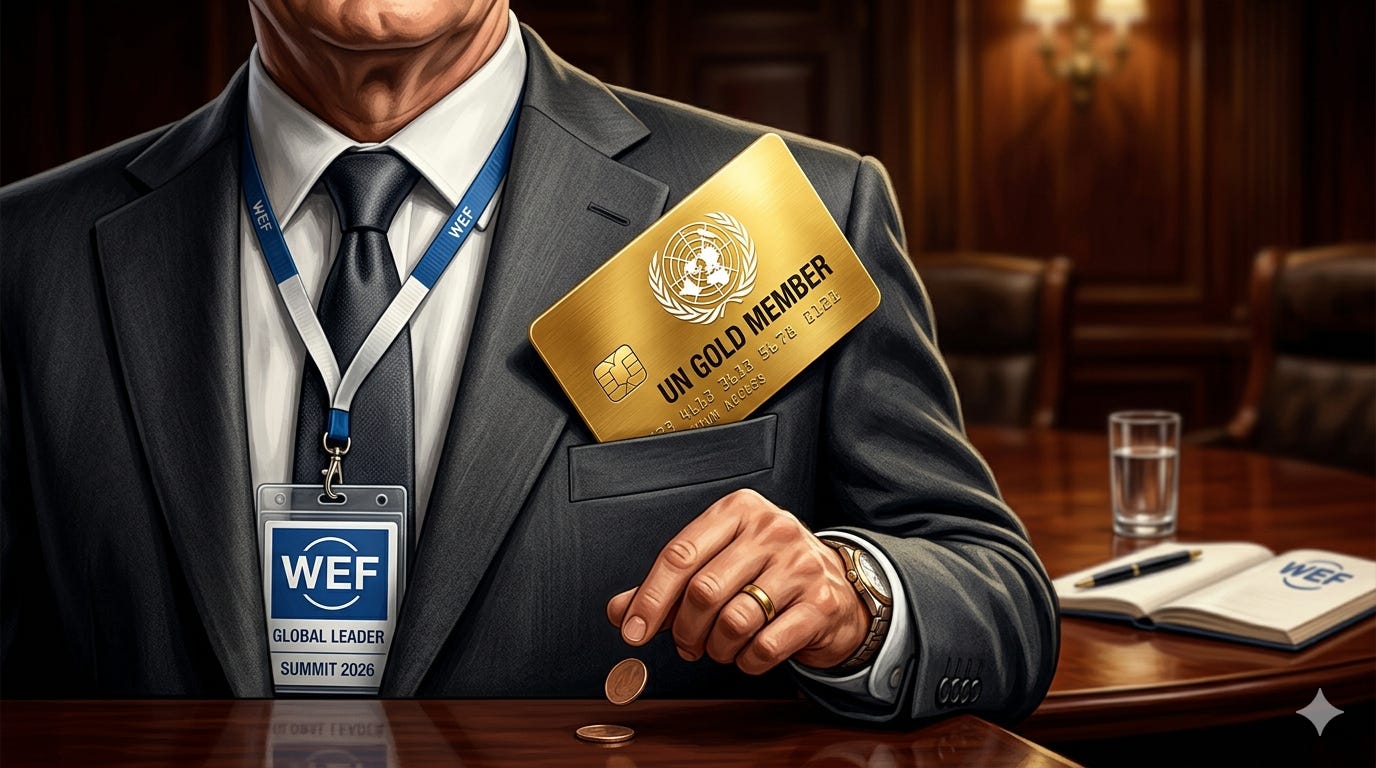
The United Nations, once positioned as the guardian of international peace and cooperation among 193 Member States, is now in freefall. What began as a quiet 2019 memorandum has metastasized into a full-blown institutional crisis. Far from saving the UN, the Strategic Partnership Framework with the World Economic Forum has accelerated its decay.
This is not mere mismanagement. It is institutional suicide — a deliberate choice by UN leadership to subordinate sovereign multilateralism to corporate multistakeholderism, only to watch the subscribers (member states) cancel their support.
The 2019 Warning: Ignored at Their Peril
In September 2019, over 400 civil society organizations — spearheaded by the Transnational Institute (TNI) and FIAN International — issued a powerful open letter to Secretary-General António Guterres. They warned that the newly signed UN-WEF Strategic Partnership would delegitimize the UN by granting transnational corporations preferential and deferential access to the system, replace rights-holders (the public, via states) with profit-driven stakeholders, and institutionalize corporate capture.
The letter explicitly stated that this partnership “will destroy the UN system, not save it.” They demanded termination of the agreement, robust conflict-of-interest safeguards, and a clear distinction between public mandates and private interests.
The UN’s response? It doubled down. The partnership — signed exclusively by Guterres, WEF’s Klaus Schwab, Amina Mohammed, and Børge Brende — embedded corporate ‘whisper advisors’ into UN departments to “accelerate” the 2030 Agenda in climate, health, digital cooperation, and more. No broad General Assembly debate. No serious oversight. An administrative MOU that bypassed democratic checks.
The signatories were proven right. The UN traded its independence for corporate alignment — and now the bill has come due.
The 100 Coalitions: Privatized Legislative Plumbing
The partnership didn’t just invite corporations to the table; it created a parallel governance structure — often referred to through dozens of “Action Coalitions,” platforms, and initiatives (part of broader multistakeholder efforts sometimes aggregated in discussions as 100 Coalitions mechanisms). These allow transnational firms to draft global standards that nations then ‘voluntarily’ adopt, effectively bypassing every parliament on Earth.
Representative examples of this privatized legislative branch:
Oil and Gas Climate Initiative (OGCI): Fossil fuel majors shaping climate ‘solutions.’
Generation Equality Action Coalitions: Corporate ‘commitment makers’ co-authoring gender and inclusion frameworks.
SDG Philanthropy Platform: Private wealth directly steering programming.
These are not neutral aid bodies. They are corporate standard-setting vehicles masquerading as humanitarian initiatives.
Spotlight: The Good Digital Identity Trap
While the UN claims financial poverty, it has simultaneously become the primary architect of a multi-billion-dollar Digital Public Infrastructure (DPI) market. At the heart of this is the Platform for Good Digital Identity — a cornerstone of the UN-WEF partnership.
What is it? Launched around 2018 to accelerate SDG 16.9 (“legal identity for all by 2030”), it is a private-sector standard-setting body. The ‘Good’ label bypasses privacy and surveillance concerns.
Who are the partners? A who’s-who of corporate interests:
Big Tech & Finance: Microsoft, Mastercard, Visa, Barclays, Deutsche Bank.
Plumbing architects: GSMA, FIDO Alliance, Linux Foundation.
Funding nodes: Omidyar Network, Bill & Melinda Gates Foundation.
This platform builds the Digital Stack binding identity to societal participation — interoperability across banking, healthcare, and government that makes opting out nearly impossible. The UN has outsourced its mandate to these firms, allowing them to define standards that create permanent, billable, trackable data streams. With traditional budgets collapsing, the UN pivots to DPI as “innovative financing” — monetizing human privacy and data to stay relevant.
The Mid-2026 Reckoning: Liquidity Crisis and Staffing Collapse
By early 2026, the consequences are undeniable. Guterres has warned of “imminent financial collapse,” with operations potentially grinding to a halt by mid-July or mid-August 2026 absent full payment of arrears. Record unpaid dues run into billions. Only a fraction of member states pay in full. The U.S. arrears loom large.
A Kafkaesque rule forces the return of unspent credits (money never collected), draining liquidity further. The 2026 budget has seen aggressive slashes, including an ~18.8–19% staffing cut and strict cash conservation. Peacekeeping, humanitarian aid, and core functions face existential threats.
This is the direct result of lost legitimacy. Nations see an organization captured by elite networks — one that lectures on sustainability from Davos while delivering paralysis on actual conflicts.
The Inversion of Duty
This is the ultimate inversion: an institution chartered to prevent the “scourge of war” has spent years acting as the concierge for interests that profit from instability. They traded the peace of nations for the profits of the coalitions. It wasn’t an accident; it was a liquidation of the public trust:
The UN avoided accountability by using a Memorandum of Understanding (MOU) rather than a Treaty. Treaties require parliamentary ratification; MOUs enable secret, administrative capture. The UN did not fail — it was bypassed by its own architects.
Point of No Return
The era of the Whisper Advisor is collapsing under its own contradictions. While Davos elites continue their galas, the New York headquarters confronts a managed blackout.
This audit is drawn from the official Memorandum of Understanding, UN budgetary reports, and open-source partnership records. While mainstream narratives frame the current collapse as a series of unrelated liquidity issues, the archival evidence reveals a singular, deliberate path: the transition from sovereign multilateralism to a privatized, unaccountable shell. The outcome is binary:
Terminal Integrity Rating: Near-zero. Financial arrears, radical staffing cuts, and mounting no-confidence votes are not mere budgetary errors—they are the final symptoms of a system that abandoned its foundational mandate.
Primary Cause of Death: Institutional suicide. By trading sovereign impartiality for corporate access, the UN cannibalized its own legitimacy. It sought “innovative financing” and privatized governance, only to find that corporate stakeholders do not pay sovereign dues.
The autopsy is complete. The UN chose its own obsolescence; sovereignty cannot be outsourced to corporate partners without due consequence.
The subscription has been cancelled.
UN's Globalist Subscription Cancelled – Terminal Bankruptcy as Reality Evicts the Phantoms

As an international organization with 193 Member States, the United Nations is uniquely positioned to address and solve global issues