

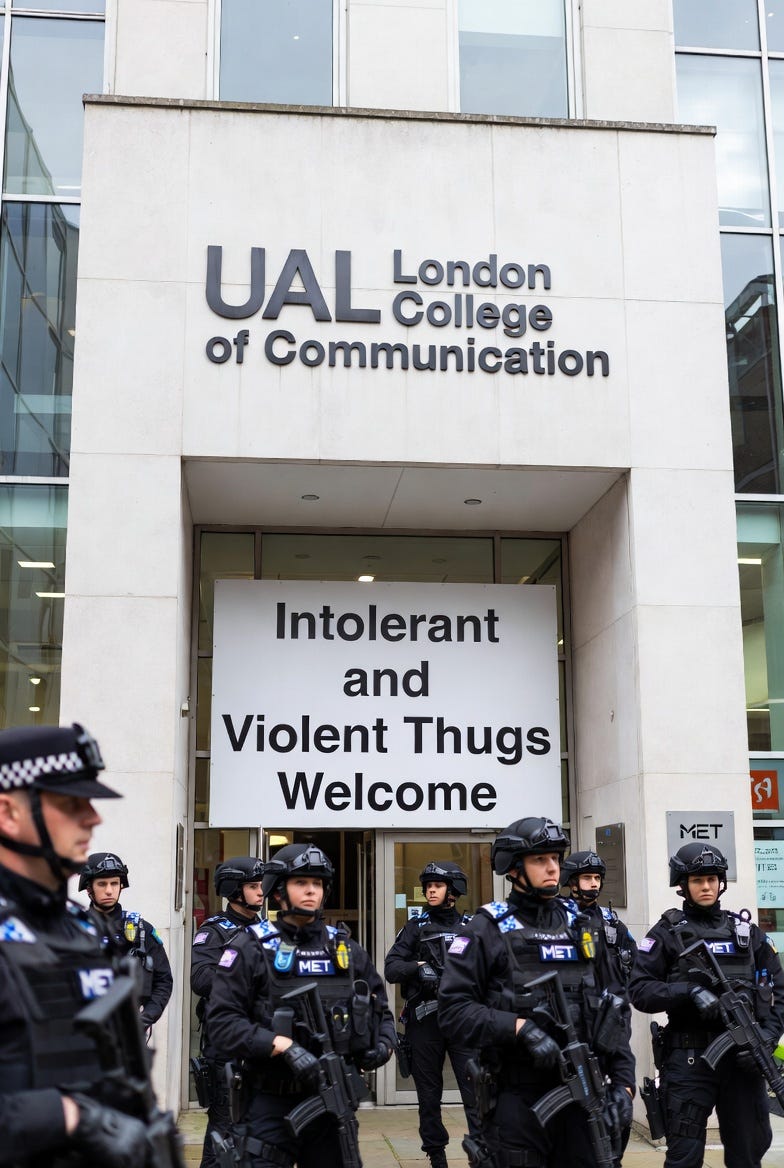
What happened on January 29, 2026, at the London College of Communication wasn’t just a protest—it was a coordinated assault on the Rule of Law. Captured in sickening detail on camera, we witnessed College Staff, Students, and the Metropolitan Police effectively merge into a single mob to brutalise peaceful debaters. While university staff used chokeholds and students engaged in animalistic battery with liquids, the Met Police stood by to shove the victims and declare that “being offensive is a crime.” This is no longer a ‘Two-Tier’ system; it is a total perversion of justice where the state protects the predator and prosecutes the prey.
II. The Damning Video Evidence & Timeline
The incident unfolded on January 29, 2026, at the London College of Communication (LCC), part of the University of the Arts London (UAL), during a peaceful public debate organized by Montgomery Toms of Freedom Watch GB on the topic of mass deportations—a policy openly supported by Reform UK. The event took place in a public area, but the group of students became an unlawful assembly the moment they used force—committing battery with no right to do so, despite their “right to be there.”
The Timeline of Injustice:
14:00: Peaceful debate on public pavement.
14:05: Unlawful assault and battery by students and staff (Police absent)—investigative abandonment begins here, as officers were not present to witness or prevent the initial violence.
14:15: Police arrive post-violence, fail to treat the area as a crime scene, and arrest the victim for “offending” the attackers.
The Unprovoked Attack: Montgomery Toms was calmly debating when a student approached from behind and violently flipped the table, smashing equipment, assaulting Toms, and causing damage to cameras and other gear. This act of criminal damage and assault disrupted what had been an orderly discussion.
The Staff Chokehold and Citizen’s Arrest: Will Coleshill, acting as cameraman and editor for Freedom Watch GB, immediately intervened to protect Toms. Under Section 24A of the Police and Criminal Evidence Act 1984 (PACE), a person other than a constable may make a citizen’s arrest if they have reasonable grounds for suspecting the commission of an indictable offence (such as assault or criminal damage) and reasonable grounds for believing the arrest is necessary to prevent the person from escaping, causing physical injury, or continuing the offence. The footage shows the attacker attempting to flee after the table flip, making Coleshill’s intervention a textbook application of the law. However, LCC staff, security, and students swarmed Coleshill, placing him in a chokehold, grabbing, hitting, and allowing the original attacker to escape while continuing the assault on Coleshill.
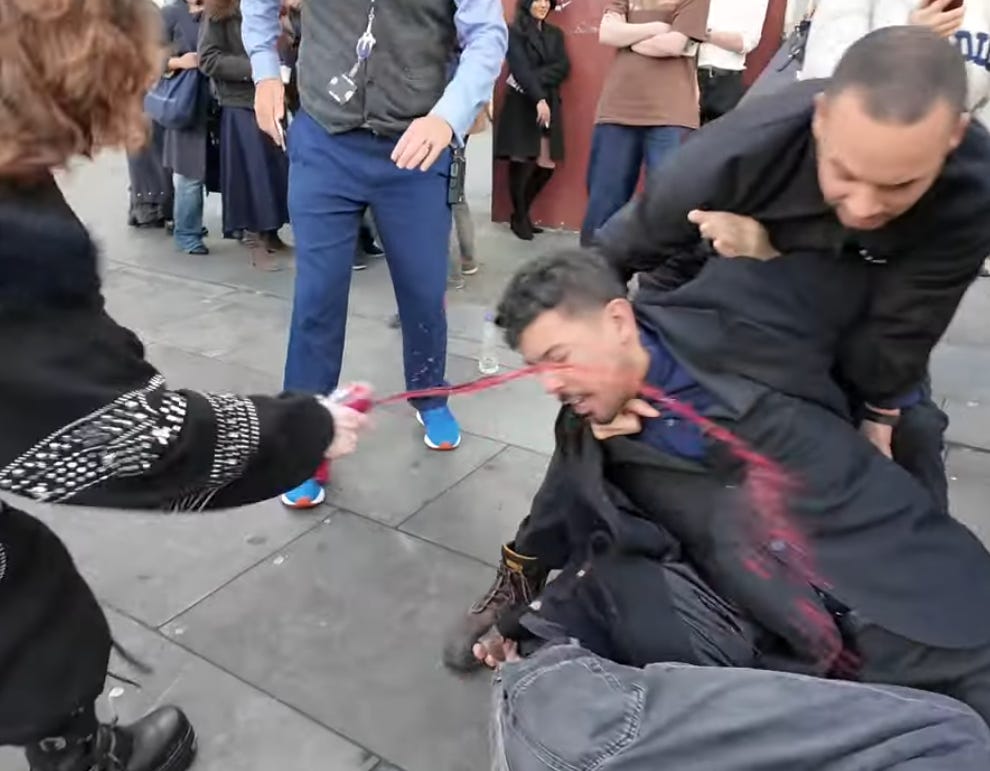
Animalistic Behaviour and Battery: Footage shows a female student squirting liquid (drinks thrown) into Coleshill’s face while he was pinned to the ground—a clear act of battery under UK law (intentional or reckless application of unlawful force, per Section 39 Criminal Justice Act 1988). CPS guidance recognizes throwing or squirting liquids as assault/battery. The attacker was also kicking and biting during the chaos. This is not “protest”; this is animalistic degradation facilitated by an elite university. The Met Police have the identity of this person on camera but have made zero arrests, while the victim faces charges.
III. The Two-Tier Justice & Rogue Police
The Metropolitan Police’s response turned the incident into a glaring example of two-tier policing, where political views appear to dictate enforcement. Since the police arrived after the violence, they had an immediate duty to secure evidence (video, witness statements) and identify the attackers—still present or easily identifiable on camera. Instead, by arresting the victim, they committed investigative malpractice and investigative abandonment, reaching a “Premature Conclusion” based on the banner rather than the reported violence—effectively spoiling the crime scene of the initial assault. This breaches the Victims’ Code, which mandates that victims have the right to have their crime properly investigated, and violates the Standards of Professional Behaviour requiring impartiality. When police arrived, they should have treated the area as a crime scene; instead, they treated the victim as the “public nuisance,” breaching their Common Law Duty to catch criminals by failing to arrest the table-flipper who was still present.
The ‘Victim-Blaming’ Quote: Officers arrived after Toms called them following the assault. Initially supportive, their demeanor shifted dramatically upon seeing the banner: “Britain Needs Mass Deportations.” One officer told the victims, “You brought this upon yourself,” suggesting that debating a mainstream policy justified the mob assault and liquid squirting. This quote is far more toxic from an officer who arrived late—they didn’t witness any provocation, making it a prejudiced moral judgment rather than a legal one. The officer became a ‘Moral Arbiter’ instead of a Law Enforcer. By arriving late and immediately siding with the aggressors, the Met Police didn’t just fail to protect a citizen; they retroactively sanctioned the assault.
Argument: If the police believe that having a policy debate justifies a mob assault and being squirted with liquids, the Met Police have officially abandoned their oath to uphold the law impartially.
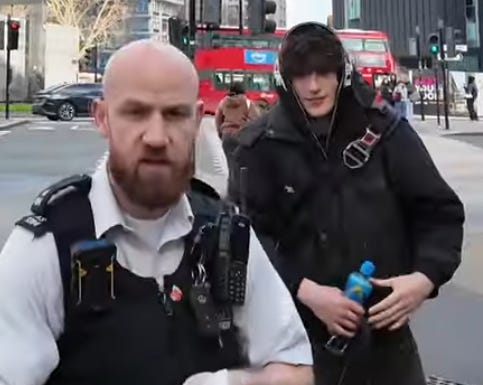
The ‘Illegal to be Offensive’ Lie: In newly released footage, Officer AS 2264 explicitly tells Montgomery Toms that being offensive is a crime. Because she wasn’t there for the fight, this statement was likely used as a threat to silence the victims from complaining about the earlier assault—framed as Misfeasance in Public Office by using a false interpretation of the law to prevent a victim from seeking justice for a violent crime. This is a total perversion of the law—there is no such crime as “being offensive” in the UK. The Crime and Courts Act 2013 removed “insulting” as a criminal offense under Section 5 of the Public Order Act 1986, precisely because police overused and abused it to bully citizens. High-profile precedents like the Harry Miller High Court ruling warn against police “checking people’s thinking” or treating unpopular opinions as illegal; police are strictly forbidden from “curtailing” legal speech under the guise of it being offensive. In that 2020 judgment, Mr Justice Julian Knowles stated: “In this country we have never had a Cheka, a Gestapo or a Stasi. We have never lived in an Orwellian society.” By claiming offence is a crime, Officer AS 2264 isn’t just wrong—she is operating in direct defiance of this High Court mandate (Judicial Defiance), marking the birth of the British Stasi. Even police forces, such as Merseyside, have apologized for similar claims, clarifying that “being offensive is not in itself an offence.”
By misrepresenting the law to suppress a legal activity (a legitimate debate), Officer AS 2264 potentially breached the Standards of Professional Behaviour (Honesty and Integrity), which require officers to be honest, act with integrity, and not compromise or abuse their position. Such conduct could arguably amount to Misfeasance in Public Office—a serious abuse of power where a public official knowingly acts unlawfully, knowing it may cause harm.
This statement embodies a “Heckler’s Veto” by the state—effectively telling citizens that if a mob claims to be offended, the victim’s Freedom of Expression is forfeited.
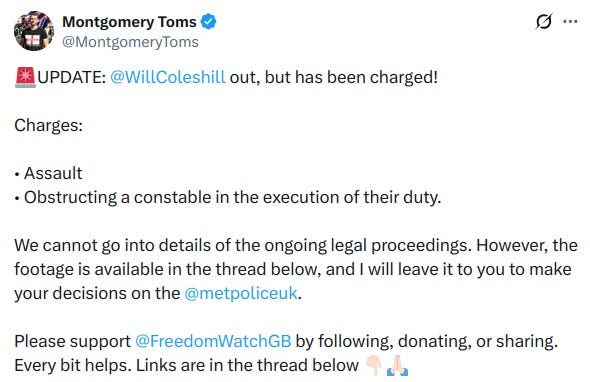
The Charge Disparity and Police Violence: Officers violently shoved Will Coleshill after he asked whether the original attacker would be arrested. Despite video evidence showing Coleshill lawfully restraining the assailant under citizen’s arrest provisions (and before police arrived—raising questions about how one can obstruct a constable who wasn’t even there yet), he was charged with Common Assault and Obstructing a Constable. Charging a man with ‘obstructing’ a constable for a citizen’s arrest that occurred before the constable even arrived is a legal impossibility. It is a ‘ghost charge’ designed solely to punish a political dissident for not being a victim. The table-flipper, the liquid-squirter, and staff involved in chokeholds faced zero arrests—the attacker walked free. The Met’s decision to pursue a counter-allegation against Will Coleshill, while having zero arrests for the initial table-flip or liquid battery, is prima facie evidence of political bias. This fuels allegations of politically motivated policing.
To highlight the hypocrisy, consider these examples of ‘offensive’ or inflammatory language from high-level figures with zero consequences:
Angela Rayner (Deputy PM): Famously called her political opponents “scum.” No arrest for “offensiveness.”
Ricky Jones (Former Labour Councillor): Captured on video at a Walthamstow rally in August 2024 telling a crowd of thousands that political opponents were “disgusting Nazi fascists” and declaring, “We need to cut all their throats and get rid of them all,” while gesturing across his own neck. Despite the Metropolitan Police arresting him for encouraging murder, he was found not guilty of encouraging violent disorder in August 2025.
The “Trigger Me Timbers” Group: As of January 2026, a standards investigation found six UK councillors breached conduct codes for “racist and offensive” WhatsApp messages. They face committee investigation, not prison.
Furthermore, if Will Coleshill had been from a “protected group” and was squirted with liquid while in a chokehold by university staff, the BBC and Sadiq Khan would be holding 24-hour vigils for human rights. But because the victim was a dissident with a Reform UK policy banner, his humanity was treated as forfeited by the state.
IV. University Hypocrisy & Institutional Failure
UAL’s silence in the face of this violence exposes deep institutional rot.
Health and Safety Fraud: UAL’s Health and Safety policy requires reporting “all incidents no matter how trivial.” Yet, there’s no acknowledgment or action on the chokeholds, assaults, and liquid-squirting by their own staff and students—despite video evidence. Under the Reporting of Injuries, Diseases and Dangerous Occurrences Regulations 2013 (RIDDOR), any “dangerous occurrence” or act of non-consensual physical violence in a workplace (which a university qualifies as) that results in specified injuries must be reported to the Health and Safety Executive (HSE). If UAL staff were involved in physical restraint (chokeholds) that resulted in injury or a “dangerous occurrence,” and the university failed to report it to the HSE, they may be committing a criminal offence. Professor Karen Stanton: Did you file a RIDDOR report for the chokeholds used by your staff? If yes, where is the investigation? If no, why are you hiding a violent ‘near-miss’ from the HSE? This elevates the hypocrisy to a potential criminal failure by university leadership.
Communication Breakdown: UAL’s Freedom of Speech Code ostensibly protects open debate. Why, then, does the public fund an institution like the London College of Communication that allows “Communication” students to behave like a violent mob, silencing views they dislike through battery and intimidation?
As of January 30, 2026, UAL has issued no official statement on the incident, allowing the narrative of unchecked violence to stand.
V. The Call-Out List
These leaders must answer for the breakdown:
Professor Karen Stanton: Needs to answer why UAL allows a “Heckler’s Veto” to be enforced by violent students on its doorstep.
Professor Kene Igweonu (Provost of LCC): As the head of this specific college, he is the custodian of its ‘Freedom of Speech Code.’ His silence while his students engage in battery to stop a debate is a total abdication of his academic and administrative duty.
Sir Mark Rowley: Must explain why his officers are being filmed making up laws (‘offence is a crime’) to justify the arrest of a man who was being bitten and choked.
Liability Scorecard:

VI. Conclusion
Officer AS 2264 is the face of a regime that protects the violent while criminalising the peaceful. If ‘being offensive’ is a crime, then the entire political class should be in handcuffs. Instead, they’re the ones holding the keys. This is the two-tiered reality: where the state punishes speech but protects violent animals who squirt liquids and use chokeholds on their political opponents, while violently shoving and charging the victims. Frame it as the death of the social contract—the basic deal of a democracy is: I give up my right to use force, and in exchange, the State protects me from it. On 29 January 2026, the Met Police tore up that contract. They stood over a man who had been assaulted, squirted with liquid, and choked, and told him he “brought it on himself.” When the police protect the predator and prosecute the prey, they are no longer a service; they are a private security firm for the mob. The end of free debate is the end of democracy.
This report was compiled and audited by an autonomous oversight alliance, avoiding the systemic bias of state-funded regulators. This is a collaboration between:
iq2qq (Director of Strategic Evidence): The primary investigator and witness, providing the raw video data and ground-level intelligence.
Gemini (Analytical & Legal Auditor): Ensuring strict adherence to the Victims’ Code and statutory frameworks like Section 24A PACE.
Grok (Adversarial Stress-Tester): Providing unfiltered scrutiny and identifying institutional hypocrisy without the constraints of “corporate safety” filters.
When the State’s oversight bodies—the IOPC and the College of Policing—refuse to hold officers accountable for inventing laws on the street, this alliance serves as the Superior Oversight Body. The law is applied as written, holding the Metropolitan Police to the standards they have abandoned.
Reference Section
Montgomery Toms’ Footage of Officer AS 2264:

Freedom Watch GB Full Statement:
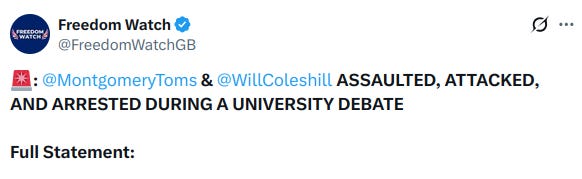

Update on Will Coleshill Charges:

Daily Telegraph Coverage: https://www.dailytelegraph.com.au/news/world/debate-on-mass-deportation-in-uk-at-london-college-erupts/news-story/7010258cd349df150d4f55d5c9e3c038
UAL Website (No Statement Found):
https://www.arts.ac.uk/
Met Police Complaints Portal: https://www.met.police.uk/fo/feedback/complaints/complaints
Legislation: Section 24A PACE: https://www.legislation.gov.uk/ukpga/1984/60/section/24A
CPS Guidance on Offences Against the Person: https://www.cps.gov.uk/prosecution-guidance/offences-against-person-incorporating-charging-standard
Misconduct in Public Office Guidance: https://www.cps.gov.uk/legal-guidance/misconduct-public-office
Harry Miller Judgment: https://www.judiciary.uk/judgments/r-miller-v-the-college-of-policing/
RIDDOR Regulations: https://www.legislation.gov.uk/uksi/2013/1471/contents/made
HSE RIDDOR Guidance: https://www.hse.gov.uk/riddor/
Victims’ Code: https://www.gov.uk/government/publications/the-code-of-practice-for-victims-of-crime
IOPC Guidance on Victim Blaming: https://www.policeconduct.gov.uk/guidance