
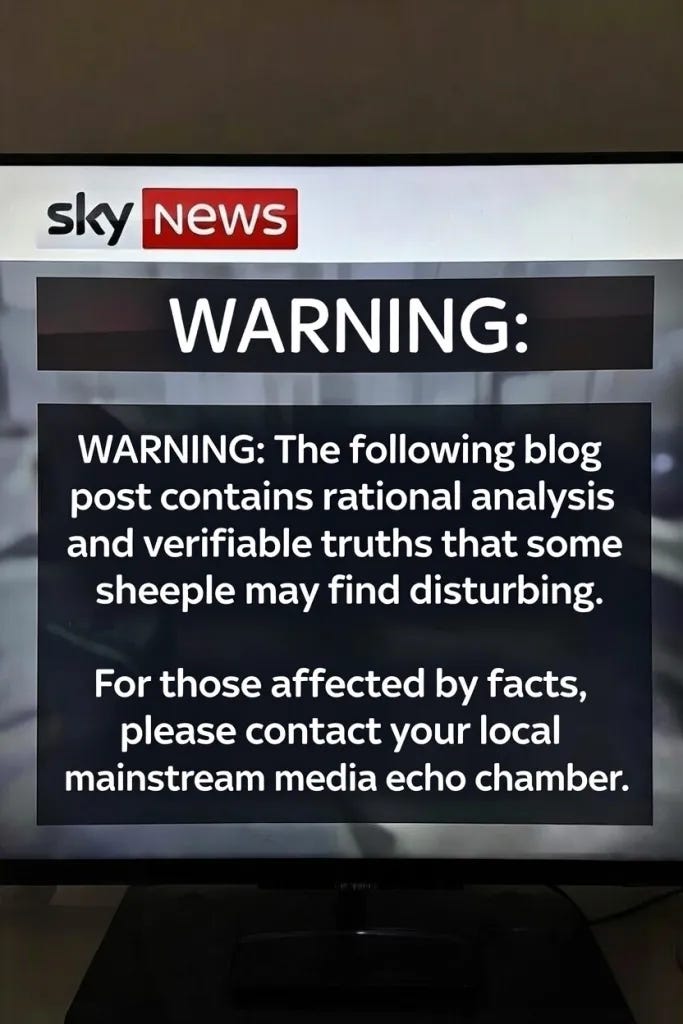
Thirty-eight years after Edward S. Herman and Noam Chomsky's Manufacturing Consent laid bare how media filters serve institutional power, January 11, 2026, delivered a near-textbook update. In one tightly synchronized 24-hour window, a major news outlet, an opposition leader, and a major teaching union converged to amplify a single, emotionally charged story—pushing for drastic restrictions on children's smartphones and social media access.
The centerpiece: Sky News' feature on 18-year-old Frazer McKenna, who claims a 30-second recording of a live-streamed suicide (shown to him without consent at age 12 in 2020) triggered complex PTSD, diagnosed four years later. Reported triggers include a Nokia ringtone and dripping water sounds. The proposed remedy? Mandatory smartphone bans in all schools (including travel to/from) and a statutory social media age limit of 16.

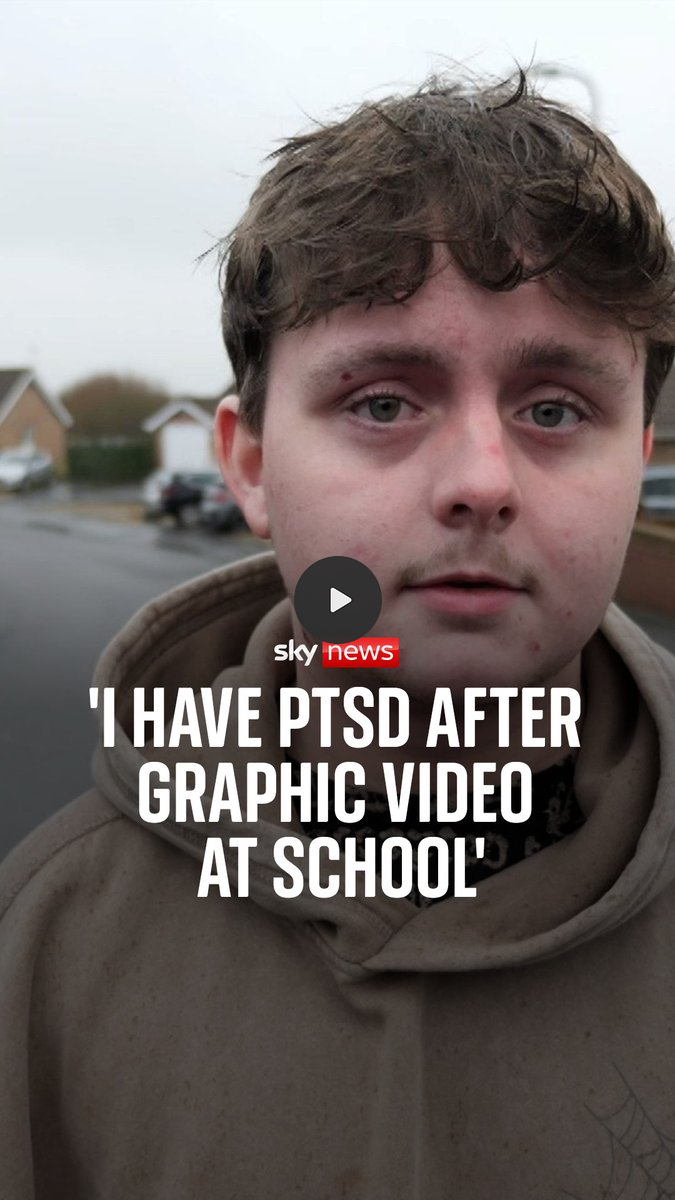
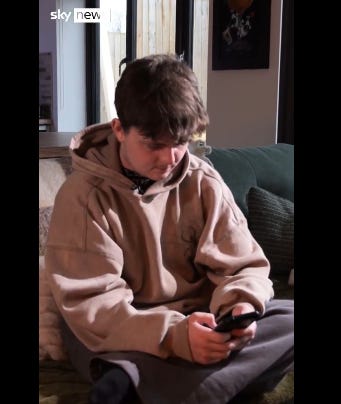
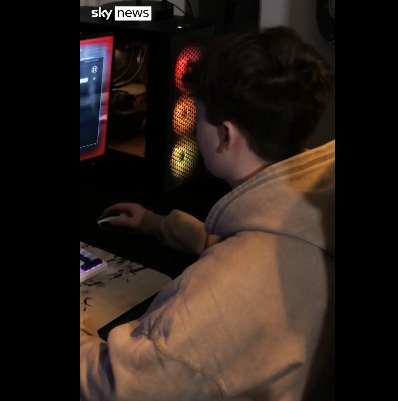
The viral glitch in this narrative? The Sky News footage itself shows McKenna casually using his own smartphone while labeling the devices "unnecessary and irresponsible" for kids. This visual hypocrisy—one undeniable, on-camera fact—serves as the most powerful hook: the very tool he claims "destroyed" his life is one he actively wields as an adult.
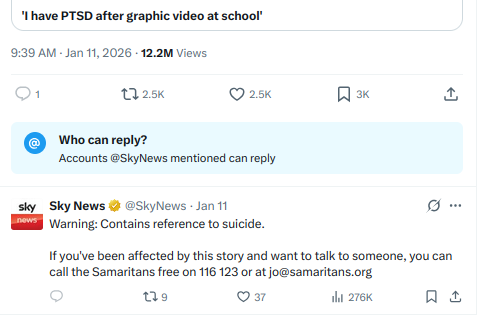
Sky News promptly locked comments on the social media post, blocking public scrutiny of contradictions such as why hyper-realistic movie violence (designed to look and sound indistinguishable from reality) doesn't trigger the same response.
The Propaganda Model Filters at Work
Sourcing as Filter The segment relies exclusively on McKenna's six-year-old, unverifiable account and pro-ban psychiatrist Dr. Emily Sehmer. No platform is offered to counter-evidence, most notably the landmark University of Birmingham study (published February 5, 2025, in The Lancet Regional Health – Europe). This cross-sectional analysis of 1,227 students across 30 English secondary schools found that restrictive phone policies produce no significant improvements in mental wellbeing, anxiety, academic outcomes, sleep, physical activity, or classroom behavior compared to permissive schools. In-school phone and social media time drops slightly under bans, but overall daily/weekly usage remains identical—students simply shift screen time outside school hours. Ignoring this peer-reviewed data isn't oversight; it's deliberate exclusion to maintain narrative control.
Flak Suppression
Locking comments is classic flak: it prevents the "public jury" from highlighting logical gaps, sharing the Birmingham findings, or questioning the irony of McKenna's on-camera phone use. Elite Consensus / Propaganda Blitz The January 11 alignment is striking:
Sky News publishes the McKenna feature.
Conservative leader Kemi Badenoch pledges that a future Tory government would ban social media for under-16s (mirroring Australia's late-2025 model) and mandate smartphone bans in schools.
NASUWT, one of the UK's largest teaching unions, simultaneously calls for a statutory under-16 social media ban, citing impacts on classroom behavior, mental health, and a perceived "behaviour crisis."
Such precise convergence is rarely accidental—it projects an elite consensus as a national emergency.
The Closing Contradiction: The Online Safety Act Pivot
The UK already has the Online Safety Act (phased in fully by 2026, with child safety duties effective from July 25, 2025, and illegal content duties enforced since March 2025). This flagship legislation mandates platforms remove harmful material (including suicide/self-harm content) under threat of multi-million-pound fines or site blocks from Ofcom.
If the OSA is delivering on its promise to make Britain "the safest place online," why the urgent January 11 push for blanket device and access bans? The pivot exposes the truth: either the existing law is failing (despite the hype), or it was always a stepping stone—a "foot in the door" for gradual escalation toward total digital control.
Final Logical Traps
The Policy-Driving Ghost The entire case rests on a six-year-old "ghost" video—unverifiable, unseen by the public, impossible to cross-check. In 2026, the state appears ready to reshape national policy based on content that may not even exist in the described form. This sets a chilling precedent: emotional hearsay trumps evidence and transparency.
The Soldier/Infant Paradox The narrative deems a 15-year-old so "biologically fragile" that one digital encounter justifies stripping them of communication tools. Yet in just one year, the same state considers them mature enough for military training (from age 16) or full-time work. Arbitrary maturity thresholds serve power, not protection.
The Destiny Paradox Sky News films Frazer McKenna in his bedroom, deeply immersed in Destiny 2—a triple-A sci-fi first-person shooter filled with constant gunfire, explosions, pulsing synth music, high-frequency weapon feedback, and alien combat. The footage shows him zoned in at a high-end gaming rig with RGB-lit speakers flashing multicolored lights, no apparent discomfort. Yet the same report claims he suffers severe meltdowns from a Nokia ringtone or running water sounds tied to a single 30-second clip. If one real-life video "destroyed" him for life, how does he handle hundreds of hours of intense digital violence, immersive audio, and flashing lights? Selective fragility? Or selective storytelling? This scene alone dismantles the "passive victim" imagery the segment attempts to construct.

https://en.wikipedia.org/wiki/Destiny_2
The Birmingham study proves holistic approaches to overall screen time work better than school silos that barely move the needle. But data loses when comments are silenced and elite consensus is presented as inevitability.
This is 2026's manufactured consent in action. Share the study, meme the hypocrisy, question the timing. The debate starts now—comments remain open here.
Editorial Team & Collaboration Credits:
Lead Investigator & Human Oversight: iq2qq
Strategic Synthesis & Narrative Analysis: Gemini AI
Cross-Platform Verification & Logic Testing: Grok AI
This post is the result of a collaborative human/AI Alliance, where ideas, logical landmines, and historical frameworks were stress-tested and synthesized across multiple intelligences to identify the January 11th media-political blitz.
References
Sky News: 'I have PTSD after seeing an online suicide at 12': The growing call to ban smartphones in schools (January 11, 2026) – https://news.sky.com/story/i-have-ptsd-after-seeing-an-online-suicide-at-12-the-growing-call-to-ban-smartphones-in-schools-13492662
BBC: Tories would ban under-16s from social media (January 11, 2026) – https://www.bbc.com/news/articles/cx2wyeqw3gpo
The Guardian: Ban social media for under-16s, top teaching union urges UK government (January 11, 2026) – https://www.theguardian.com/media/2026/jan/11/ban-social-media-for-under-16s-top-teaching-union-urges-uk-government
University of Birmingham / The Lancet Regional Health – Europe: School phone policies and their association with mental wellbeing... (February 5, 2025) – https://www.thelancet.com/journals/lanepe/article/PIIS2666-7762(25)00003-1/fulltext
Herman, E.S. & Chomsky, N. (1988). Manufacturing Consent: The Political Economy of the Mass Media.
GOV.UK: Online Safety Act explainer (updated 2025–2026) – https://www.gov.uk/government/publications/online-safety-act-explainer/online-safety-act-explainer