

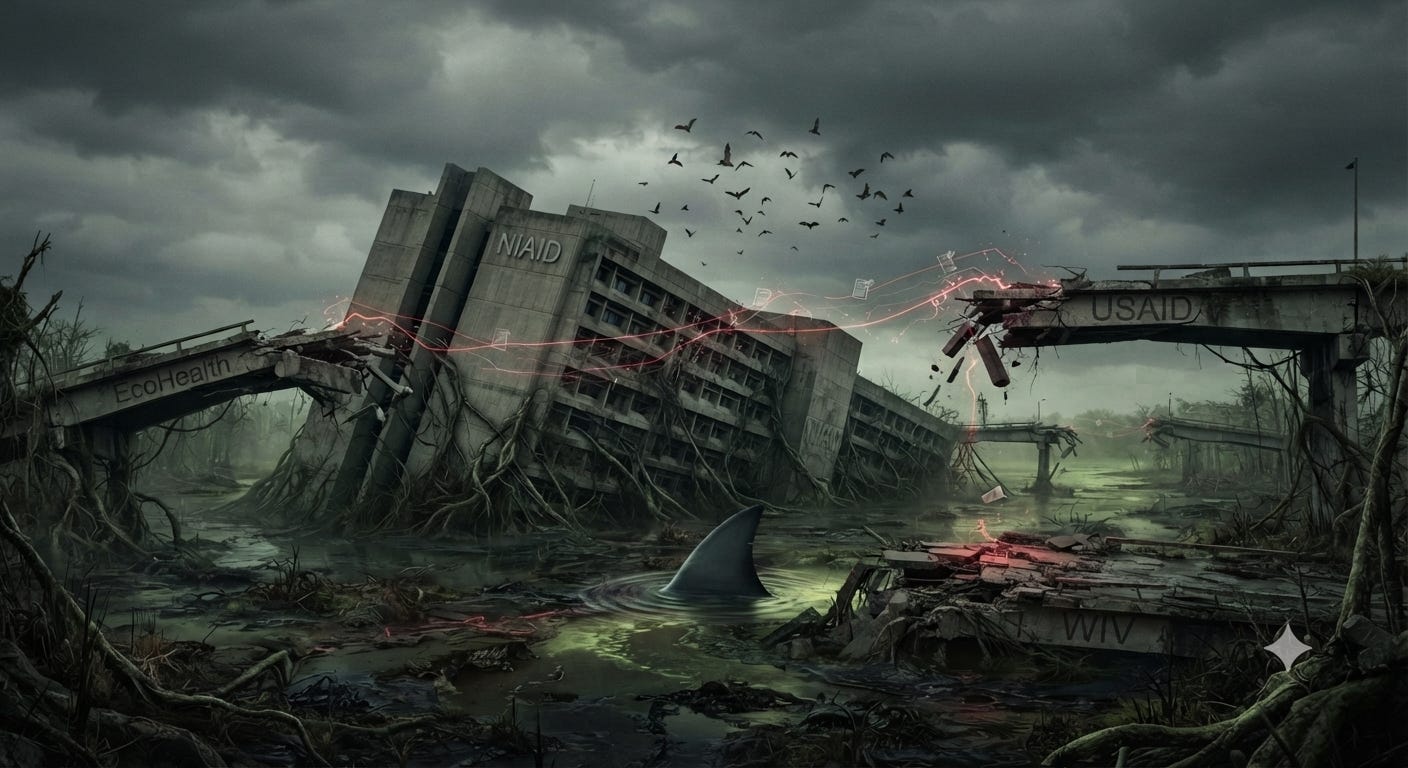
In November 2018, U.S. Customs and Border Protection officers at Detroit Metropolitan Airport intercepted a courier carrying three undeclared vials concealed in paper towels and wax film. The courier explicitly named the source as Yusen Zhou of China’s Academy of Military Medical Sciences. Joint DHS/FBI laboratory testing identified partial immunoglobulin mRNA and porcine epidemic diarrhea virus spike-protein material—a coronavirus. The intended recipient network centered on an NIH/NIAID-funded laboratory at the University of Minnesota. The same courier was stopped again in June 2021, this time carrying 132 undeclared vials and a laptop that did not belong to him.
This was not a one-off lapse. It was a repeated method of moving biological materials outside regulated channels, spanning years under the same funding umbrella. Months before the 2018 intercept, Wuhan Institute of Virology scientist Zhengli Shi had proposed that a student simply carry monoclonal antibodies from the United States to China. The American collaborator flagged the geopolitical risk and recommended a formal shipment. The pattern of informal, undeclared transfer proposals and executions was already in place.
These details, drawn from Customs and Border Protection records released by Senator Rand Paul in July 2026, sit alongside Anthony Fauci’s own contemporaneous notes from early 2020. In those notes, senior scientists, including Fauci, privately discussed the unusual furin-cleavage site and the possibility of a laboratory-associated origin. Publicly, the message hardened with remarkable speed into a single permissible story: natural zoonosis only. Questions about the research network were increasingly treated as ‘misinformation’.
That gap—between private recognition of risk and public enforcement of certainty—is the heart of the matter.
The Architecture
The network was a publicly funded research ecosystem in which personnel, materials, and money moved across institutional and national boundaries with incomplete safeguards. NIAID under Fauci supported coronavirus work through intermediaries such as EcoHealth Alliance. That funding reached the Wuhan Institute of Virology and related collaborators. U.S. academic laboratories, including Fang Li’s group at the University of Minnesota, participated in the same scientific conversations and material exchanges.
The network included individuals with training or employment ties to Chinese military medical institutions. The courier’s statement bound the intercepted materials directly to Yusen Zhou of the Academy of Military Medical Sciences. Other participants had affiliations or prior training linked to People’s Liberation Army-associated facilities that were not always fully disclosed on visa or research paperwork. What was presented as civilian academic exchange operated with military-adjacent personnel in the loop.
The funding and material pipeline was not restricted to a single agency. Records from parallel federal programs, such as USAID’s PREDICT initiative, show that thousands of viral samples—including close relatives of coronavirus strains—were collected and routed through institutional arrangements involving intermediaries like EcoHealth Alliance and personnel including Peter Daszak. Budget documents for PREDICT-2 list institutional lead compensation for Daszak and subagreements involving Chinese institutions, among them the Wuhan Institute of Virology. Reporting based on previously unreleased documents indicates that samples moved to Wuhan laboratories over a multi-year period, in some cases without formal agreements governing long-term storage, access, or dual-use safeguards. This distributed structure ensured that multiple federal channels simultaneously fed resources and materials into the same transnational network.
High-consequence research on bat SARS-like coronaviruses, including experiments examining or enhancing features relevant to human infectivity, was conducted inside this web. The definitive blueprint for this work emerged in the 2018 Project DEFUSE proposal, drafted by EcoHealth Alliance. This plan specifically detailed an intention to genetically engineer bat coronaviruses by inserting a furin cleavage site—a specific chemical "key"—into SARS-like viruses to evaluate how easily they could infect human cells. While the U.S. military agency DARPA denied formal funding due to the severe dual-use biosafety risks, internal records indicate that members of the transnational network pursued the project’s objectives using alternative resource pipelines. When SARS-CoV-2 emerged in Wuhan a year later, it featured the exact, ultra-rare furin cleavage site described in the DEFUSE blueprint—a genetic feature never before observed in that specific family of natural bat viruses.
Instead of maintaining strict oversight over these volatile concepts, the network relied on incredibly porous operational channels. Biological materials moved across borders outside standard regulatory view. Formal protocols existed on paper, but in practice, proposals to hand-carry samples and actual concealed shipments occurred—as demonstrated by the airport intercepts. Serious biosafety concerns regarding containment procedures at the Wuhan end of the network had already been officially raised by U.S. embassy diplomats years prior, yet the financial and material pipeline remained active.
These risks were not newly discovered in 2020. In the 1977 book Ecoscience: Population, Resources, Environment, co-authored by John P. Holdren (later Obama-Biden White House science adviser), the authors explicitly warned that biological warfare laboratories and genetic-engineering labs were potential sources of accidental escape of lethal agents. They noted the historical reality of biological agents being transported on commercial airliners, the inherent unsafety of virus laboratories, and the catastrophic potential of such work. Their conclusion was unambiguous: “It is essential that some way be found to block all further work on biological weapons—the risk for humanity is simply too great.”
Decades later, the bureaucracy that included Holdren and the agencies that funded the transnational coronavirus network did not block the work. They managed it. On January 9, 2017—eleven days before the presidential transition—the White House Office of Science and Technology Policy, then led by Holdren, issued the Recommended Policy Guidance for Potential Pandemic Pathogen Care and Oversight (P3CO). That framework established the administrative path for reviewing and potentially resuming the very category of high-risk research that had been under a funding pause since 2014.
Anthony Fauci made this public declaration at Georgetown University on January 11:

NIH formally lifted the high-risk research pause in December 2017 after HHS issued its implementing framework. The timing placed the regulatory groundwork for continued high-consequence work in the final window of one administration, with limited immediate visibility for the incoming one.
The system that emerged combined ambitious science, porous transfer practices, dual-use collaborators, incomplete disclosure of affiliations, long-documented knowledge of the exact failure modes, multi-agency funding streams, and a structure that distributed operational responsibility while concentrating prestige and budget authority at the top.
The Reflex
When the outbreak began, the same institutions did not open the books. They managed liability. Definitions of gain-of-function research were narrowed in ways that insulated prior grant decisions. Funding relationships were publicly distanced. Private communication channels and record-management practices appeared in oversight materials. The label ‘misinformation’ was applied to the very laboratory-origin questions that early private scientific discussions had treated as legitimate.
A prominent early example of this preemptive containment appeared in February 2020, when The Lancet published a statement strongly condemning “conspiracy theories suggesting that COVID-19 does not have a natural origin”. The letter was organized by a scientist (Peter Daszak) whose organization, EcoHealth Alliance, had funded and collaborated on research at the Wuhan Institute of Virology—an undisclosed conflict of interest at the time. The statement functioned as an authoritative firewall, establishing a rapid consensus against laboratory-origin inquiry before fuller investigation or document releases could take hold.
As the months pressed on, mainstream media outlets acted as the force multiplier for this containment. By February 2021, platforms were seamlessly translating preliminary international body conclusions into closed-fact proclamations, while leaning heavily on figures like Peter Daszak himself to redirect public scrutiny entirely toward market supply chains.
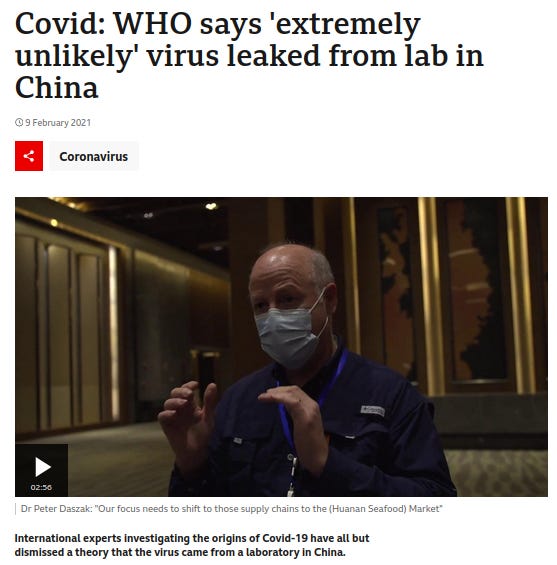
https://www.bbc.co.uk/news/world-asia-china-55996728
This pattern extended directly into the interagency handling of alternative analyses. On the exact day alternative origin reports were published in September 2020, the Department of Homeland Security requested that the Intelligence Community analyze and discuss the findings. Contemporaneous records show that individuals within the State Department’s Bureau of Intelligence and Research (INR) immediately dismissed the report as “nonsense” without a genuine technical review, noting that its conclusions conflicted with the prevailing natural-origin narrative. In June 2026, declassified communications and documents released by Director of National Intelligence Tulsi Gabbard further exposed how Anthony Fauci worked with politicized leadership within the Intelligence Community to shape assessments, suppress the lab-leak origin hypothesis, and obscure U.S. funding lines for the high-consequence research in question. The release also asserts that Fauci later denied under oath knowledge of or participation in discussions with intelligence officials about the viral research—contradicting the newly declassified record.
This was not merely a scientific disagreement. It was institutional self-defense across both public-health and intelligence channels. An agency complex that funds a high-risk transnational network, oversees an environment in which undeclared material transfers occur, and then moves to shape intelligence assessments and police inquiry once a pandemic emerges cannot credibly claim pure ignorance as an exculpatory defense. At best it is gross negligence in oversight. At worst it is the predictable behavior of a bureaucracy whose primary reflex is to protect its budgets, its prestige, and its personnel from the consequences of the system it built and funded.
Fauci’s notes from January and February 2020 show awareness of the genetic anomalies and the laboratory context. The public posture that followed emphasized natural origin with a confidence the private record did not fully support. That discrepancy is now documented in both contemporaneous notes and declassified intelligence materials. The same institutions that had been warned in print since the 1970s about laboratory escapes and informal biological transport responded to the real-world test by prioritizing narrative control over transparent investigation.
Why These Actors?
For any hypothesis involving a research-related origin—whether an accidental breach during high-risk work or something more deliberate—
This network is the central subject of interest. Geography, research focus, funding trails across multiple agencies, documented material movement outside regulated channels, military-adjacent personnel ties, the long-standing knowledge of the precise risks, the administrative path cleared for the research in 2017, the post-outbreak campaign of narrative control (including the early Lancet statement), and the newly declassified record of influence over intelligence assessments all converge here.
Capability and opportunity are established by the paper trail. The subsequent prioritization of self-preservation over transparent investigation is also established. This isn’t definite proof that SARS-CoV-2 was engineered in a laboratory or intentionally released. It does constitute proof that the system was structured in a way that made such an outcome more feasible and full accountability far more difficult. When the stewards of high-risk research—armed with decades of explicit warnings—respond to catastrophe by narrowing definitions, restricting data, shaping intelligence products, and treating legitimate safety questions as misinformation, they confirm the core public suspicion: that protecting the institution ranked supreme over what the institution had enabled.
The perfect conditions for catastrophe were constructed with taxpayer money, under the authority of the officials (such as NIAID Director Anthony Fauci, the highest-paid employee in the entire U.S. federal government) later presented as the sole reliable guides through the crisis.

https://www.whitehouse.gov/presidential-actions/2025/06/reviewing-certain-presidential-actions/
References
Forbes, Adam Andrzejewski, Dr. Anthony Fauci: The Highest Paid Employee In The Entire U.S. Federal Government, January 2021: https://www.forbes.com/sites/adamandrzejewski/2021/01/25/dr-anthony-fauci-the-highest-paid-employee-in-the-entire-us-federal-government/
Calisher et al., Statement in support of the scientists, public health professionals, and medical professionals of China combatting COVID-19, The Lancet, 19 February 2020 (organized with undisclosed EcoHealth Alliance involvement).
EcoHealth Alliance, Project DEFUSE: Defusing the Threat of Bat-borne Coronaviruses (2018 DARPA Grant Proposal). Document archive and investigative report via The Intercept: theintercept.com (Full text files also preserved via the Zenodo Academic Repository: zenodo.org).
Daily Caller News Foundation reporting on USAID PREDICT program viral sample shipments to Wuhan (July 2025): https://dailycaller.com/2025/07/08/exclusive-usaid-sent-viruses-ccp-linked-biolab/
Ehrlich, Paul R., Anne H. Ehrlich, and John P. Holdren. Ecoscience: Population, Resources, Environment. W.H. Freeman, 1977. (Relevant passages on biological warfare laboratories, laboratory escapes, and transport of agents; archival copies available via Internet Archive)
Fox News coverage of the CBP intercept documents (July 2026): https://www.foxnews.com/politics/cbp-intercepted-biological-materials-tied-u-s-china-virus-network-before-covid-new-documents-show
National Institutes of Health, National Center for Biotechnology Information. The Furin Cleavage Site Is Key to SARS-CoV-2 Pathogenesis, PubMed Central (PMC): nih.gov: https://pmc.ncbi.nlm.nih.gov/articles/PMC7457603/
NIH Funding Pause Removal Notice: National Institutes of Health, Notice Number NOT-OD-17-071, Notice Announcing the Removal of the Funding Pause for Gain-of-Function Research Projects, December 19, 2017: https://grants.nih.gov/grants/guide/notice-files/NOT-OD-17-071.html
Office of Science and Technology Policy, Recommended Policy Guidance for Departmental Development of Review Mechanisms for Potential Pandemic Pathogen Care and Oversight (P3CO), January 9, 2017: https://web.archive.org/web/20200715022653/https://www.phe.gov/s3/dualuse/Documents/P3CO-FinalGuidanceStatement.pdf
Office of the Director of National Intelligence (ODNI). Report on Fauci-funded Wuhan lab research, 2026: https://www.odni.gov/index.php/newsroom/reports-publications/reports-publications-2026/4165-fauci-funded-wuhan-lab-research-that-sparked-covid
PREDICT-2 EcoHealth Alliance subagreement budget documents (publicly circulated records showing institutional lead allocations).
Senator Rand Paul. Tony’s Diary Package – Anthony Fauci’s contemporaneous notes, July 2026: https://www.paul.senate.gov/wp-content/uploads/2026/08/2026.07.24_Tonys-Diary-Package.pdf
Senator Rand Paul. Senator Rand Paul Reading Room (public archive of COVID-19 origins investigation documents): https://www.paul.senate.gov/readingroom/
Senator Rand Paul. U.S. Customs and Border Protection Field Information Report on University of Minnesota Professor and Virologist Fang Li and Associates, July 2026: https://www.paul.senate.gov/wp-content/uploads/2026/07/FINAL-CBP-Release-Package.pdf (Alternative archive: https://www.paul.senate.gov/final-cbp-release-package/)
The American Report. 11 Days Before Trump Took Office, Obama-Biden White House Depopulation Science Czar Holdren Advised Lifting Gain-of-Function Research Ban, June 14, 2021: https://theamericanreport.org/2021/06/14/covid-19-11-days-before-trump-took-office-obama-biden-white-house-depopulation-science-czar-holdren-advised-lifting-gain-of-function-research-ban-trump-kept-in-the-dark/
The Washington Post, Josh Rogin, April 2020: State Department cables warned of safety issues at Wuhan lab studying bat coronaviruses
U.S. Right to Know (USRTK). Unredacted Proximal Origin Scientist Slack Communications Database (February 2020 internal logs): https://usrtk.org/wp-content/uploads/2023/10/Proximal_Origin_Slack_OCRd.pdf
Yan, Li-Meng (@DrLiMengYAN1). Analysis of Declassified ODNI Communications and September 2020 Interagency Response. Thread Reader App archive of X thread, June 19, 2026: https://threadreaderapp.com/thread/2067988039867957464.html
Yan, Li-Meng, Shu Kang, and Shanchang Hu. Unusual Features of the SARS-CoV-2 Genome Suggesting Sophisticated Laboratory Modification Rather Than Natural Evolution and Delineation of Its Probable Synthetic Route. Zenodo, September 14, 2020: https://zenodo.org/records/4028830
NIAID Official Pleads Guilty in COVID-19 Records Cover-Up: The Institutional Walls Begin to Crumble
·
The facade is cracking. For years, the public was fed a tightly managed narrative regarding the origins of the COVID-19 pandemic, while institutional gatekeepers worked behind the scenes to shield their funding lines, obscure cross-border material transfers, and evade public scrutiny.
