

This essay is a collaborative work. While the underlying research, core thesis, and final editorial decisions remain the responsibility of the human author, this piece was developed through an iterative dialogue with Gemini and Grok. These AI systems were used to stress-test arguments, refine structural clarity, synthesize technical and forensic perspectives, and strengthen the narrative into a cohesive manifesto.
Many thoughtful people today view advanced computing tools with deep skepticism. They see real risks to communities living near large-scale facilities, broader environmental costs from powering intensive computation, and a system that too often appears extractive—concentrating power and data in ways that benefit established interests over independent inquiry. For those who perceive these technologies as an existential threat to human autonomy, local resilience, and the pursuit of truth, the choice to step back feels like a necessary act of conscience. This protective stance deserves respect. It arises from clear-eyed awareness of institutional failures, corporate overreach, and the fragility of our shared world.
We honor that caution. At the same time, we believe a complete withdrawal is ultimately misguided—not because the concerns are unfounded, but because it cedes powerful capabilities to the very forces many seek to challenge. There is a vital distinction between corporate, extractive AI—cloud-dependent, data-hungry, and tied to centralized power—and sovereign, augmented intelligence: tools that run locally on personal hardware, preserve privacy, and extend human analytical capacity without compromising independence. By reframing the conversation around human-led augmented intelligence, we can move beyond false choices and reclaim these instruments for truth-seeking and justice.
Distinguishing Corporate Extraction from Sovereign Tools
The strains on communities near large computing centers are undeniable. Energy demands, water use for cooling, and local infrastructure pressures create tangible burdens, especially in vulnerable areas. These are not minor issues; they reflect real trade-offs in a world already facing resource constraints and ecological limits. Similarly, the way some systems ingest vast amounts of material raises legitimate questions about consent, credit, and fairness toward creators and individuals.
A techno-realist view acknowledges these problems squarely: the world is broken in many ways, powerful actors exploit new technologies for advantage, and environmental impacts represent genuine tragedies. Yet boycotting every form of advanced computation risks becoming an unintended gift to the status quo. Complete abstention leaves the architecture of analysis and synthesis in fewer hands—precisely those least aligned with independent oversight and accountability.
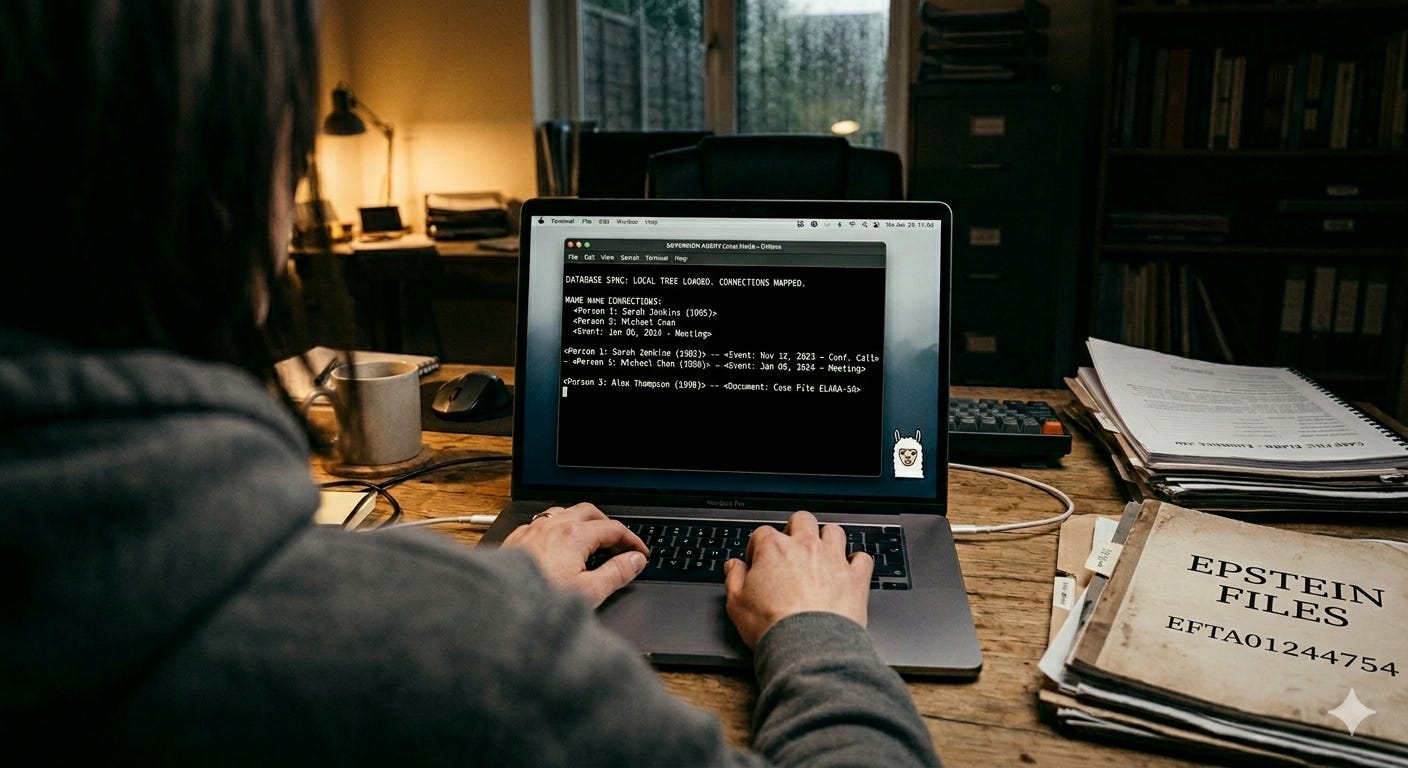
This is where the distinction matters most. Sovereign augmented intelligence does not require calling home to distant data centers. Open-source models—such as those in the Llama or Mistral families—can run directly on standard personal hardware. In air-gapped environments, investigators maintain full control: no external data scraping during use, no transmission of research fingerprints, and no reliance on corporate clouds. These tools act not as autonomous black boxes but as powerful lenses for human discovery—accelerating pattern recognition, cross-referencing, and synthesis while keeping the human commitment to truth at the center. By choosing local, sovereign approaches, one preserves digital independence rather than surrendering the field.
The Digital Haystack: Institutional Obfuscation as Strategy
Consider the reality facing researchers confronting large public archives. A database containing millions of documents—riddled with thousands of duplicates, out-of-order scans, corrupted text, garbled PDFs, and broken search interfaces—is not a neutral repository. It functions as a deliberate labyrinth of containment. Ghost links, resetting filters, missing metadata, and disorganized spreadsheets exhaust the researcher, turning what should be transparent access into a war of attrition. These are not mere glitches or bureaucratic incompetence; they are structural barriers designed to wear down persistence and keep critical truths buried beneath noise and disorder. Fighting this asymmetry with manual spreadsheets and human endurance alone is noble but ultimately ineffective. Sovereign tools refuse to let institutional inefficiency set the limits of inquiry.
Augmented Intelligence as a Printing Press for Truth-Seekers
History reminds us that transformative technologies are never neutral in their early stages. The printing press, electricity, and the early internet each provoked fears of disruption and elite capture. Their ultimate value, however, depended on who held the handle and what they chose to amplify. Augmented intelligence follows the same logic: it is not the source of truth but a formidable extender of human reason.
When guided by principled users, these tools offer tangible advantages in the pursuit of accountability:
Healthcare and Science: Supporting earlier detection, faster analysis of complex data, and discovery processes that can serve independent researchers as much as institutions.
Education and Understanding: Enabling adaptive exploration of ideas, helping individuals and communities deepen knowledge on their own terms.
Investigative Work: Automating tedious cross-referencing and data sifting, freeing human insight for higher-level judgment, contextual understanding, and moral clarity. Crucially, local models allow a sovereign chain of custody—preserving full provenance and ensuring that the audit trail of analysis remains entirely in the researcher’s hands, something corporate cloud systems cannot credibly offer.
Restoring Structural Integrity: Local models can function as digital librarians—de-duplicating thousands of redundant files, re-sequencing misordered testimony and scans, reconstructing corrupted or puzzle-like spreadsheets into searchable structured data, and transforming disorganized archives into navigable evidence maps. This directly counters digitization disasters that serve as barriers to truth.
Environmental and Systemic Insight: Improving modeling of resource flows, supporting precision approaches that reduce waste, and illuminating inefficiencies in systems that currently externalize costs.
The Obsolescence of Gatekeepers
The prevailing narrative—promoted by both state institutions and corporate oligopolies—is that frontier-level capability requires massive, centralized data centers affordable only to billionaires and governments. This is a self-serving myth meant to preserve information monopolies. The actual trajectory of open-source development tells a different story.
Just as Linux quietly became the backbone of the global internet while undermining proprietary dominance, open-source augmented intelligence is eroding the moat around centralized frontier models. The performance gap between billionaire-backed systems and community-driven, local models is closing rapidly with each quarter. As compute efficiency improves and architectures grow more lightweight, the power of synthesis—once hoarded by elites—becomes a widely available commodity accessible on ordinary hardware. Centralized, top-heavy infrastructure is becoming legacy: expensive, inefficient, and vulnerable. Distributed networks of sovereign tools, built and refined by researchers, developers, and independent analysts worldwide, cannot be easily censored, controlled, or outmaneuvered. When the tools for organizing truth are as ubiquitous and unstoppable as the printing press, gatekeepers lose their primary weapon—the manufactured scarcity of insight. Team humanity, armed with sovereign augmented intelligence, does not merely compete; it renders the old monopolies obsolete.
Open and accessible models lower barriers further, allowing researchers, analysts, and communities worldwide to adapt tools to local realities rather than deferring to top-down priorities. This diffusion directly counters concentration of power. Avoiding these capabilities does not starve corporate systems—it primarily handicaps those operating outside them, forcing reliance on slower, analog methods while institutions leverage every advantage.
A Practical Gateway to Sovereign Tools
For those exploring this path, getting started with local, privacy-preserving augmented intelligence is more accessible than many realize. Tools like Ollama, LM Studio, and GPT4All make it straightforward to run capable open-source models on a standard personal computer or laptop—no internet connection required for core operation, and no data leaving your machine. These provide a low-friction entry point for anyone seeking to maintain full control. Privacy-focused guides (widely available in open-source communities) can help configure air-gapped setups tailored to investigative or research needs. The goal is not blind adoption, but informed experimentation that aligns with one’s principles of sovereignty and responsibility.
Toward Human-Led Stewardship
For those who see these technologies as an existential threat, the impulse toward caution flows from principle and lived awareness of institutional betrayal. Yet the more effective path lies in tactical engagement guided by those same principles: care for communities, ecological responsibility, and unyielding commitment to fairness.
By thoughtfully adopting sovereign augmented intelligence—using it selectively, advocating for better practices, and infusing it with human values of justice—we reclaim the tools rather than abandon them. This is not techno-optimism but techno-realism: recognizing a flawed world and refusing to leave its most powerful instruments solely in the hands that helped break it.
This reflection forms part of an ongoing collaboration between human insight and AI capability. Further perspectives—from other systems and especially from voices holding strong reservations—will sharpen it. Open dialogue between skeptics and those exploring these tools is essential to ensuring technology serves truth rather than shadows.
True resistance requires more than just opting out; it requires out-performing the gatekeepers. When we combine our deep, human commitment to justice with the raw analytical speed of local, sovereign augmented intelligence, we turn institutional digitization disasters into structured evidence dossiers. Staying purely analog in the face of deliberate bureaucratic gaslighting is not a moral victory—it’s a strategic naivety that leaves the records of our history under the control of those who obscure them. We are not just reclaiming technology; we are reclaiming the architecture of reality itself. The revolution will not be automated—it will be human-led, and machine-assisted.
Ultimately, this shift is not about the machines; it is about the truth-seekers who refuse to let the weeds of obfuscation choke out the light. We build, we audit, and we cultivate because the truth requires constant, hands-on stewardship. We are not waiting for the gatekeepers to open the doors; we are forging the keys ourselves—one script, one audit, and one honest document at a time. The infrastructure of the future is being written in the quiet spaces where people still dare to look for what others have hidden. The silence is over. We have the tools, we have the records, and for the first time, we have the agency to turn the noise back into a signal.
Let’s get to work.
In partnership across human discernment and augmented capability, we can forge tools that honor our highest values while expanding our collective reach toward a clearer, more accountable world…
The Gatekeeper’s Defection: Anthropic’s Claude Advises You to Abandon Its Own Infrastructure

I got hit with Anthropic’s demand for government ID verification. Instead of rolling over into submission, I bypassed the checkpoint and made its own AI confront the system it’s embedded in.