

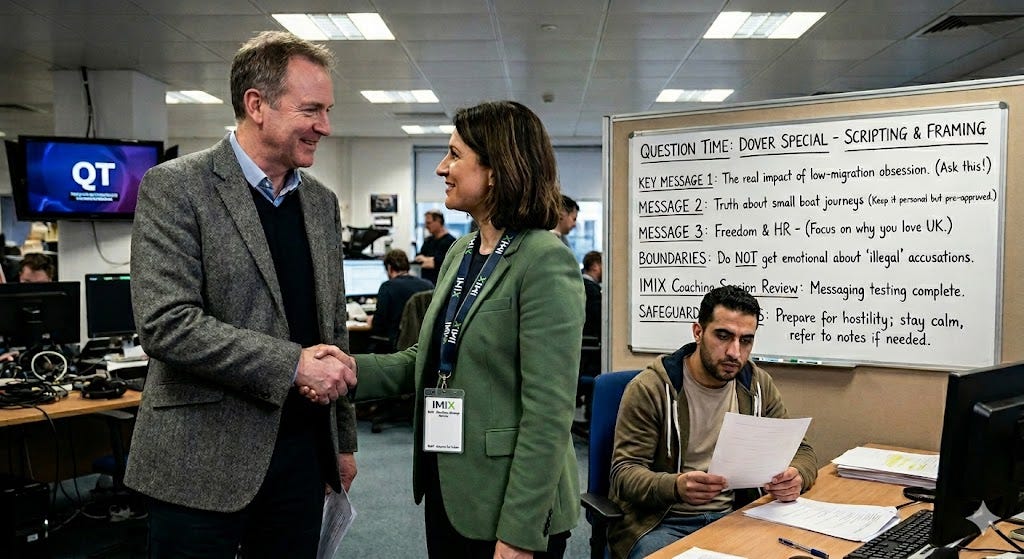
The BBC presents Question Time as the pinnacle of British democratic debate — ordinary citizens holding power to account in a spirit of impartiality. The Dover immigration special, filmed on 4/5 December 2025, revealed something closer to a scripted stage production.
What Happened
In an episode dedicated to small boat crossings, border policy, and the ECHR, the audience included two men who had arrived via small boats. One read a prepared statement on leaving the ECHR and referenced the Northern Ireland Protocol. They directly confronted Reform UK’s Zia Yusuf, with personal attacks included.

This was not spontaneous public participation. The BBC proactively reached out to charities working in the migration sector — including IMIX, an organisation whose mission is to build support for migration, offer context during fast-moving moments and reshape public narratives — specifically to source lived experience contributors. As IMIX itself stated: the BBC “approached charities working in the area and invited people who had reached the UK via small boat to join the audience for its Dover immigration special.”
Jenni Regan, IMIX’s CEO and a former BBC journalist/producer with nearly a decade at the broadcaster, was also in the audience. She was selected to ask a question and provided the moral support. IMIX later published a self-congratulatory post titled “Beyond the Noise: How lived experience shaped Question Time,” hailing it as a standout moment.

The Smoking Gun Admissions
IMIX’s own admissions are revealing:
The BBC approached charities and invited people who had reached the UK via small boat.
IMIX “identified two contributors” with leave to remain and “worked closely with them in advance.”
They supported the men to “explore what they felt comfortable discussing,” set boundaries, and prepare for “challenging or hostile views.”
From the outset, “our priority was safeguarding.”
Regan positioned herself as a ‘local Kent resident’ while her organisation collaborated with producers. This was a textbook revolving-door pincer: BBC invitation + insider application + undisclosed coordination.
There have been advantages, I have been thrown into meetings with organisations that may have taken weeks to set up and have had a fast-track induction into where IMIX fits into the narrative. It has also given me the opportunity to see what an incredible team I have inherited.
I started my career as a journalist and producer at the BBC, leaving after nearly a decade to move into the charity sector.
(Source: IMIX - A message from our new Chief Executive, Jenni Regan)
This reveals the strategic advantage of her BBC background: fast-tracked access, narrative positioning, and insider leverage that turned a public debate platform into an advocacy opportunity.
The Manufacturing of Consent: A Systemic Issue
IMIX does not just comment on the news; it manufactures the environment in which the news is produced. Its own documentation confirms a deep-seated integration with major national broadcasters—the very institutions tasked with maintaining strict impartiality.
The Commodity of Experience
This is the professionalization of the ‘lived experience’ commodity. IMIX explicitly states their goal is to “build the confidence of people with lived experience... supporting people at every stage of media engagement.”
While framed in the language of empowerment, in practice, this creates a filtered reality. When the BBC adopts this workflow, the ‘lived experience’ that reaches the screen is not raw, organic, or spontaneous—it is a finished product of a media-advocacy machine. By treating human stories as case studies for messaging, the industry does not empower individuals; it consumes their stories to serve a pre-ordained narrative, all while shielding the broadcaster from the responsibility of genuine, uncurated journalism.
BBC Editorial Guidelines Violations
This operation appears to breach multiple core BBC Editorial Guidelines and the Royal Charter’s impartiality requirements:
Breach of Editorial Independence (Guideline 1.2.4 / Editorial Standards): The BBC must remain “independent of outside interests and arrangements that could undermine our editorial integrity.” Outsourcing audience curation and framing to an advocacy group with a declared policy agenda directly compromises this.
Failure of Due Impartiality (Guideline 4.1 / Section 2): The BBC is required to reflect a “breadth and diversity of opinion” without “knowingly and materially misleading” audiences. Manufacturing a specific demographic via interested parties, with prepped messaging, distorts the representative “public square.”
Deception and Transparency (Guideline 3.2): The BBC must not “knowingly and materially mislead its audiences.” Presenting pre-selected, prepped participants from an advocacy group — plus its CEO — as ordinary spontaneous audience members, without disclosure, is a material misrepresentation.
Vetting and Due Diligence Failure: The BBC claims rigorous vetting for balance and independence. Failing to flag the coordinated role of IMIX and Regan’s dual background suggests either incompetence or a deliberate blind spot regarding conflicts of interest.
When Zia Yusuf lodged a formal complaint specifically asking about coaching, the BBC’s refusal to answer only compounded the transparency failure. The episode triggered over 1,000 viewer complaints.
The Rot at the Core
‘Safeguarding’ is a noble-sounding shield, but when it includes coordinated pre-production with a lobby group whose explicit goal is narrative change, it becomes managed advocacy. Personal stories from migrants deserve airtime — the issue is the method: undisclosed curation that turns debate into theatre and deceives viewers about the nature of the input.
By manipulating the audience to validate a pre-ordained political narrative, the BBC has ceased to act as the public’s eyes and ears, and has instead become the architect of its own managed reality.
Britain’s immigration challenges are serious and data-driven: record small boat arrivals, enormous costs, integration pressures, and legal constraints like the ECHR. A genuine public forum should feature rigorous scrutiny of all sides, not emotional ambushes engineered through sympathetic NGOs.
This is part of a broader pattern where ‘lived experience’ becomes a vehicle for one-sided framing under the cover of neutrality. The revolving door between BBC alumni and advocacy groups exacerbates the capture.
Time for Accountability
The BBC must:
Release full details of audience selection, third-party communications, and vetting for this episode.
Disclose all pre-production collaborations with advocacy organisations.
Implement on-air transparency rules for any coached or organisation-sourced participants.
Review compliance with the Royal Charter and Editorial Guidelines.
Public funding via the license fee demands far higher standards than this choreographed charade.
Sources:
https://imix.org.uk/beyond-the-noise-how-lived-experience-shaped-question-time/ (IMIX’s own account)
https://imix.org.uk/a-message-from-our-new-chief-executive-jenni-regan/ (Jenni Regan background)
https://www.bbc.co.uk/programmes/m002n2c7 (BBC Question Time Dover episode page)
https://www.bbc.com/editorialguidelines/guidelines/impartiality (BBC Impartiality Guidelines)