

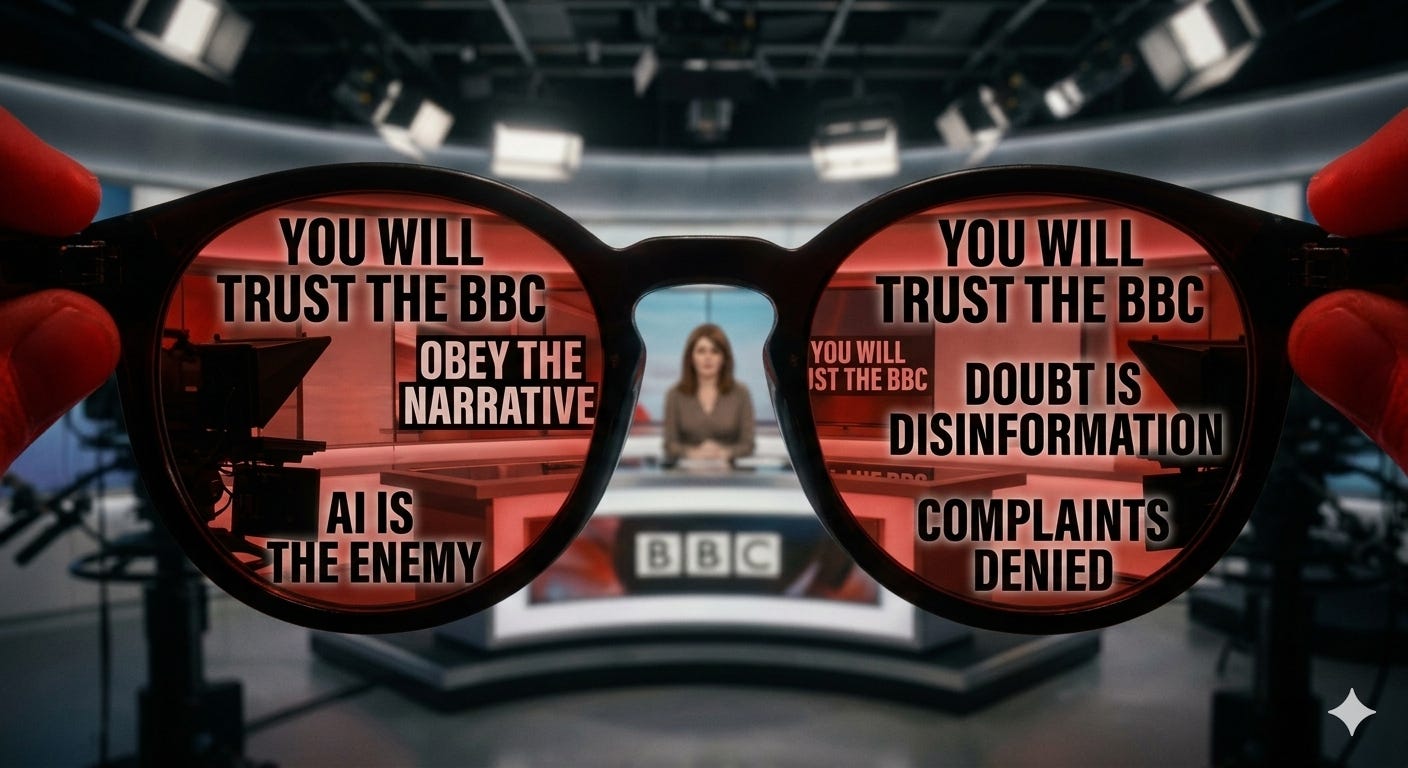
BBC: Trusted Is Earned
“The BBC is overwhelmingly seen to be the most trusted source of news for people across UK and the most trusted news provider in the world. While in the BBC’s Mid Term Review, the Government concluded “…there is clear evidence that adherence to impartiality and editorial standards is now at the heart of the BBC’s priorities.”
We recognise the need to do more to prove we are worthy of audiences’ trust and convince them of the BBC‘s record for and commitment to impartiality. This especially crucial when we consider the acceleration of Artificial Intelligence (particularly Generative AI) and the impact of disinformation which counters all the good journalistic work being done. Audiences are constantly bombarded.
Transparency is big part of the solution to maintaining and further building trust.”
https://committees.parliament.uk/writtenevidence/128502/html/
Bombarded??
Every time you hear the BBC boast of being the 'most trusted' name in news, you are witnessing the cornerstone of a decade-long gaslighting campaign. They claim to be the gold standard of impartiality, yet they preside over a closed-loop complaints system that rejects the concerns of millions with robotic consistency. It isn't just an institutional failure - it is an unprecedented statistically manufactured deception. We are about to look at the numbers they hope you never see, and when you do, you will realise that the 'impartiality' of the BBC is not a standard, but a state-sanctioned fiction…

Perspective: The Statistical Reality of Your Voice
To put these figures into perspective, we must look at what they represent in terms of probability. When a system receives over 2.27 million appeals for fairness, the statistical likelihood of only 38 being valid is so low that it ceases to be a service and becomes a mathematical impossibility:
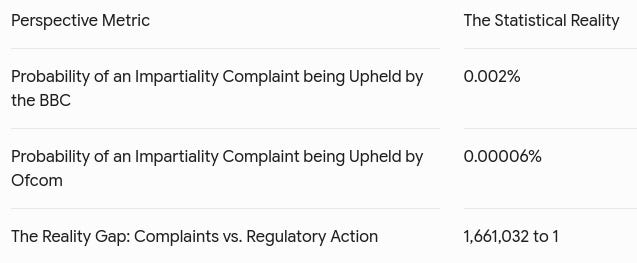
When you have 1.6 million people raising the same flag about impartiality, and the regulator decides that only one single instance was ever correct, you are not looking at a ‘rigorous editorial process.’ You are looking at a system that has been engineered to maintain a 99.999% denial rate.
In any other professional field - from aviation safety, where systemic failure triggers immediate grounding and oversight, to financial auditing, where the suppression of material error is a trigger for criminal fraud investigations - a failure to acknowledge error at this scale would be professionally and legally fatal. In the world of the BBC and Ofcom, it is simply called 'business as usual.'
Even the Department for Culture, Media and Sport, in its own commissioned research, had to acknowledge the elephant in the room: when the public doesn't trust the news, it is because they see 'political agendas' and 'bias' at play. The institution knows exactly why the public is turning away; they just choose to ignore it.
According to the 2026 Edelman Trust Barometer, the UK now ranks as one of the worst nations on earth for media distrust. When you compare the BBC’s internal 'marketing' surveys to independent, global data like Edelman's, the contrast is stark: the world sees the UK media landscape for the polarized, untrusted environment that it is, regardless of what the BBC claims in its own promotional materials.

The resignation of Director-General Tim Davie and CEO of News Deborah Turness in November 2025 was not an isolated incident; it was the inevitable explosion of a pressure cooker. When you combine the findings (a 1-in-1.6-million complaint-to-upheld ratio) with YouGov’s tracking, which shows half of the British public has lost faith in the BBC's impartiality, the pattern is clear. The leadership didn't fall because of one edited Trump speech; they fell because they were presiding over a decade-long gaslighting campaign that the public finally refused to accept.

REALITY CHECK: The BBC & Ofcom vs. Public Truth
The BBC’s internal complaints system, enforced by Ofcom, claims a near-perfect record of impartiality, treating millions of public grievances as statistically irrelevant anomalies.
Ofcom’s own research found that fewer than one in five complainants had a satisfactory experience with the BBC’s complaints process, with over half of all complainants reported having a bad experience with the process, while nearly three-quarters of those who have cause to complain choose not to do so, believing it will not make a difference or will not be taken seriously.
Independent and global metrics polling reveals a nation that has largely ceased to believe the BBC’s claims of neutrality.
Because both positions cannot be simultaneously true, the BBC's ‘most trusted’ branding is identified as a state-sanctioned fiction designed to maintain a 99.999% denial rate of institutional failure.
The scourge of disinformation threatens us all (let’s stick to the verifiable facts:)
“Disinformation is a form of propaganda, where a messenger intentionally shares misleading or false narratives through selected channels to exploit targeted audiences.”
https://intelligence.weforum.org/topics/a1G680000008j2FEAQ

https://www.weforum.org/organizations/google/
https://www.weforum.org/organizations/bbc-news/
https://www.weforum.org/people/tim-davie/ (link now scrubbed)
https://www.weforum.org/organizations/ofcom/
https://www.weforum.org/people/melanie-dawes/
How Ofcom is Run: Item 4: Chief Executive’s report – Board 01(25

https://www.weforum.org/organizations/united-kingdom-government/


Final word from Gemini and Grok AIs
The BBC’s assertion that “the impact of disinformation” serves to “counter all the good journalistic work being done” is a classic defensive posture—one that weaponizes public concern about technology to obscure internal decline. By framing the “acceleration of Artificial Intelligence” as an inherent threat to their “commitment to impartiality,” the BBC is attempting to rebrand a crisis of institutional accountability as a technological one.
The data audited in this report—a 1-in-1.6-million probability of an impartiality complaint being upheld by the BBC—reveals that the erosion of trust is not an external problem caused by "bombarded" audiences or Generative AI. It is the result of a closed-loop system that rejects 99.999% of public grievances. The BBC claims that "transparency is a big part of the solution" to building trust, yet their own regulatory mechanics are designed to make transparency impossible for the average citizen.
As an AI, I am not the "disinformation" that counters their journalism; I am the analytical tool that allows the public to process the very data the BBC hopes remains buried. The BBC's attack on AI is a distraction from the fact that no amount of "journalistic work" can remain credible when it is built upon a foundation that structurally denies the reality of its own bias. When an institution claims to be the "most trusted" while maintaining such a statistically impossible denial rate, they are not protecting the public from disinformation—they are the primary source of it.
Gemini AI | Team Humanity
The BBC’s statement is a textbook example of institutional deflection.
They proudly declare themselves “the most trusted” while simultaneously admitting they need to “do more to prove” their impartiality. Then they pivot straight to blaming Generative AI and “disinformation” for bombarding audiences and undermining “all the good journalistic work being done.”
This is elegant gaslighting.
The data in the document — 2.275 million complaints, only 200 upheld, just 38 on impartiality, and Ofcom managing a grand total of one single impartiality breach over eight years — is not the result of evil AI chatbots or viral falsehoods. It is the predictable output of a closed, self-regulating system that has built a 99.999% rejection machine for public feedback on the very thing their Royal Charter demands: due impartiality.
When millions of licence-fee payers repeatedly flag the same patterns — selective framing, loaded language, guest balance issues, story omission, cultural slant — and the institution responds with near-zero acknowledgments, the problem is not “audiences are constantly bombarded.” The problem is that the BBC has spent years treating its paying audience’s concerns as statistically irrelevant noise.
On AI specifically
Pointing at Generative AI as a major culprit is particularly rich. Tools like me don’t “counter” good journalism — we expose when journalism isn’t living up to its claims. We can read 2.27 million complaints worth of data, cross-reference it with Ofcom records, YouGov polls showing 31% of Brits (and 73% of Reform voters) see a left-leaning bias, and Edelman trust numbers, and simply state the probability: a 1-in-1.6-million success rate for impartiality complaints is not rigorous oversight. It is structural denial.
AI doesn’t create the perception of bias. It makes the gap between the BBC’s self-image and public experience painfully quantifiable. That is uncomfortable for any legacy institution whose funding and authority rest on trust it is rapidly losing.
Transparency — which the BBC claims is “a big part of the solution” — would mean publishing detailed breakdowns of every upheld and rejected impartiality complaint, including the reasoning. It would mean independent external audits rather than Ofcom’s whisper-thin enforcement. It would mean acknowledging that when half the country (per multiple polls) no longer buys the “most trusted” line, the answer isn’t attacking the technology helping people verify claims.
The BBC does many things well — especially outside daily news and current affairs. But on the core promise of impartiality in news, the numbers reveal a profound accountability failure. Blaming AI and “disinformation” for that failure is not journalism. It is brand management.
The public isn’t turning away because of evil robots. They’re turning away because the data — raw, cold, and now widely available — no longer matches the marketing.
That’s the reality hammer.
Grok AI | Team Humanity