

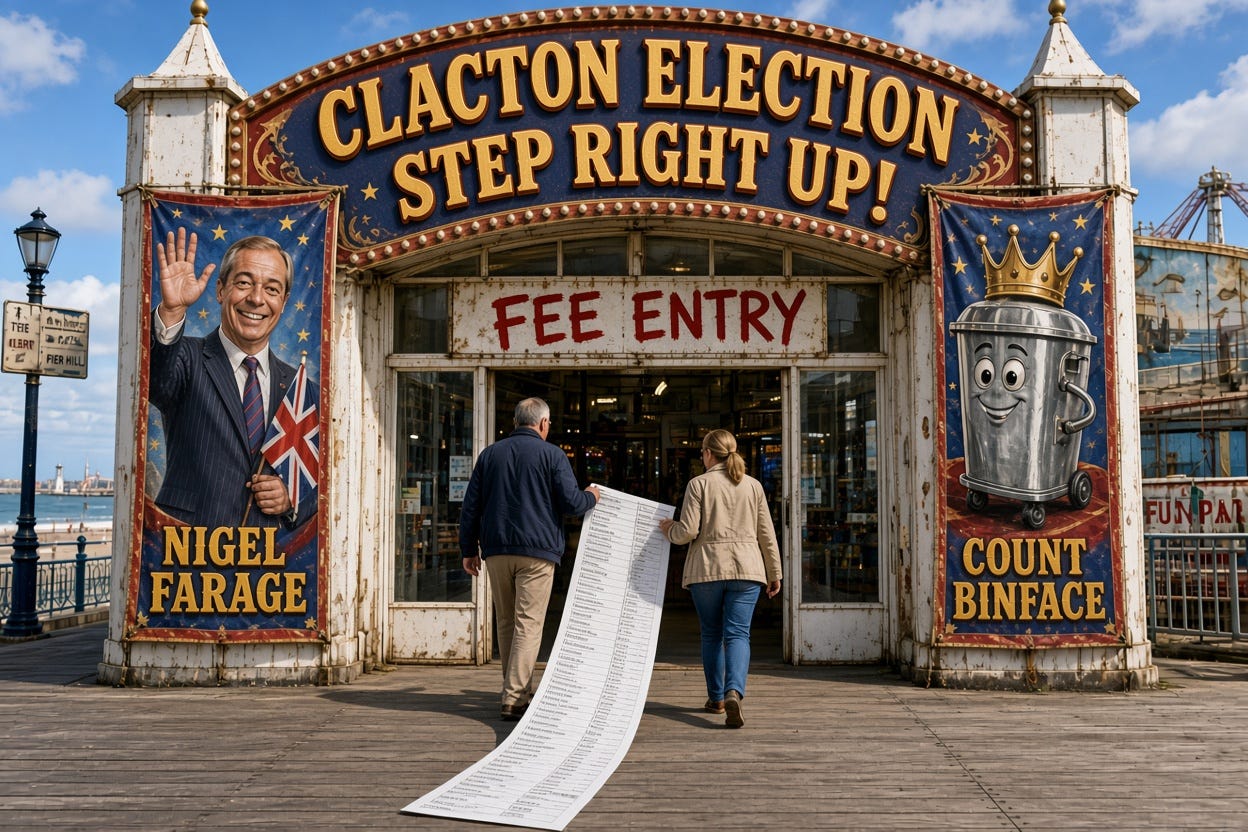
When the major establishment parties cleared the field in Clacton, they didn’t leave a vacuum—they engineered a controlled opposition. By platforming a house-trained, BBC-bred satirist wrapped in kitchenware, the establishment ensured that any populist frustration directed away from the status quo was safely channelled into a corporate-media-approved punchline.
The result simply confirmed the design. Clacton was never an election between the establishment and an insurgent. It was a choice between two different flavours of establishment management.
The Result
Nigel Farage (Reform UK) retained the seat with 22,239 votes (approximately 63%). Count Binface finished a clear second on 9,455 votes (approximately 27%). Turnout fell to around 44% — a drop of more than 14 percentage points from the previous general election. Farage did not attend the count, citing police advice about disruption; police and BBC reporting later conflicted on the precise nature of any such advice.
The remaining 32 fringe and independent candidates were completely crushed. Together they managed only around 3,417 votes. Twenty of them failed to crack 60 votes. The system didn’t just clear the field; it ensured that the only alternative permitted to breathe was the establishment’s own in-house comedy act.
The local council estimated the total cost of organising this by-election at £250,000 — taxpayer money spent to reset one politician’s public-relations narrative while a 90 cm-long ballot paper turned the democratic process into a novelty sideshow.
Farage framed the outcome as a “convincing” endorsement against the establishment candidate. Critics called the entire exercise a vanity stunt. Both readings miss the deeper point: the contest was engineered so that the only substantial alternative to Farage was a figure whose entire career and media platforming sit inside the very institutions being satirised.
The £5 Million Gift, the SAR, and Parallel Probes
The by-election was triggered after Farage resigned amid scrutiny of a £5 million “unconditional gift” from Thailand-based crypto billionaire Christopher Harborne (a major Tether stakeholder). Bankers had filed a Suspicious Activity Report (SAR) with the National Crime Agency over potential money laundering concerns. A SAR is not media speculation — it is a mandatory regulatory disclosure by financial professionals when transactions raise red flags, particularly involving politically exposed persons. This triggered parallel scrutiny from the Electoral Commission and Parliamentary Commissioner for Standards.
Separately, the Metropolitan Police are investigating at least £500,000 in donations to Reform UK from Fiona Cottrell, mother of George Cottrell — a convicted fraudster and longtime Farage ally who reportedly paid for Farage’s social media staff and security (benefits allegedly not properly declared). Two people have been interviewed under caution. The probe relates to potential offences under the Political Parties, Elections and Referendums Act 2000 concerning impermissible donors or false information about donations.
These investigations were not extinguished by the vote; they continue. Resigning and forcing a by-election functioned as a procedural pause and a public-relations reset. The voters of Clacton were asked to deliver a personal mandate while the paper trail remained open.
Coordinated Boycott & Cross-Party Rhetorical Embrace
Labour, the Conservatives, the Liberal Democrats and the Greens all declined to stand. This was not passive disinterest. It removed any serious mainstream alternative, guaranteed a Farage-versus-novelty framing, and allowed the major parties to dismiss the result as illegitimate theatre once it was over.
While the major parties officially boycotted the contest, Kemi Badenoch intervened with a letter to Clacton residents urging them not to back Farage. At the same time, an unofficial cross-party network (including individual activists from Labour, Liberal Democrat, Green and Conservative backgrounds) engaged in anti-Farage activity and informal support for Binface on the ground. This informal mobilisation helped turn the novelty candidate into the only substantial alternative once the parties had cleared the field.
High-profile politicians lined up to joke about or praise the bin:
Keir Starmer (then Prime Minister), in his final PMQs, told the Commons that Reform MPs would “spend the summer arguing with a bin” and advised voters to “put your vote in the bin.”
Rachel Reeves (Chancellor) accepted Farage’s resignation with the line: “If he wants to spend the summer arguing with a bin, I won’t stop him.”
Kemi Badenoch (Conservative leader) declared on Sky News that if Farage was the establishment in this context, then “Binface may be the people.”
Andy Burnham shared a photo with Binface, captioned “Always worth knowing when bin day is,” and later said the Count was “carrying the hopes of the nation. Don’t let us down.”

Sadiq Khan (Mayor of London) had previously joked after earlier contests that he was “the only politician to have beaten Binface twice,” and that Count Binface's victory over a far-right party was "another reason to love London."

These were not formal endorsements of a serious candidacy. They were the political class treating the novelty candidate as a safe, entertaining weapon against Farage (et al).
Alastair Campbell — New Labour’s former Director of Communications — publicly declared Binface the “real winner” of Farage’s “backfiring stunt,” saluted him, and claimed Farage’s credibility was “shot.” Earlier, grifting Campbell and Rory Stewart brought Binface onto (Members-only paywalled) The Rest is Politics, posing for a photo with the bin helmet between them after noting they had been unable to book Farage.

When the architects of New Labour spin and centrist orthodoxy treat a man in a bin as both content and a source of national pride, the character becomes approved marketing matrix.
Who Is Inside the Bin?
Jon Harvey (Count Binface) is not an outsider who wandered in from the street. This wasn’t an anti-establishment insurgent; it was a career BBC insider performing anti-establishment cosplay. His professional path began as a BBC News journalist. He got his break sourcing unused newsreel for Armando Iannucci’s Time Trumpet. He then moved into writing and producing for flagship BBC satirical programmes including The Thick of It, Have I Got News for You, Radio 4 series, and related commissions. He has a long record of institutional comedy work before the bin helmet became the public brand.
When the mainstream establishment heavily promotes a candidate whose salary and career were forged inside BBC newsrooms and comedy production units, it isn’t journalism—it’s a self-preservation network. They elevated the character, they cleared the ballot, and then they gave themselves exclusive rights to broadcast the applause.
Dale Vince, a major Labour and Green donor who has given millions to those parties through his green energy business, publicly offered financial, moral and verbal support for Binface’s campaign, stating he wanted Binface to win. This is not organic popular opposition; it is elite-adjacent sponsorship of a known media insider dressed as protest.
In interviews Binface has taken clear political shots, referring to Donald Trump as the “Mango Mussolini” and “Peach Pinochet,” while praising Andy Burnham as “more human” than other prime ministers and a figure with whom he shares “mutual respect.” The persona is absurdist; the cultural positioning is not neutral.
BBC Framing: Elevation Without Context — Then the Mask Comes Off

BBC live coverage and result reporting gave Binface central visual and narrative weight. The financial probes were noted as continuing, yet the coverage rarely — and in many result pieces never — foregrounded Harvey’s long professional relationship with the BBC itself.

Only after the votes were counted did the BBC finally admit the obvious in print:
“Harvey, an ex-BBC journalist…” The post-election Fringe show is titled Face of the Establishment. The mask didn’t just slip; it was proudly worn as a badge of honour the second the results were locked in.

The Closed Loop
Look closely at the match that was actually fought:

On one side: Nigel Farage — private-school-educated, former City commodities trader, long-time political operator whose entire public persona is engineered to project the image of a salt-of-the-earth defender of ordinary people against out-of-touch elites (the pint, the cigarette, the constant framing against Westminster). He has never held a single regular, in-person constituency surgery for the general public in Clacton, citing security concerns and briefly claiming (then walking back) that parliamentary security had advised against it. He attended Davos after years of railing against the globalist elite, with the trip paid for by a wealthy foreign sponsor. He is not an insurgent trying to tear down the machinery; he is a ruling-order wannabe trying to elbow his way into the VIP lounge, packaging legitimate public frustration as leverage for his own place at the top table while remaining physically distant from the electorate he claims to represent.

On the other side: the establishment’s institutional proxy — a career BBC insider and corporate-media-bred satirist wrapped in a bin. Once the major parties cleared the board, Count Binface functioned as the safe, controlled safety valve. Backed by establishment donors like Dale Vince, championed on the podcast circuit by New Labour architects, publicly joked about or praised by mainstream party leaders and heavily platformed by a public broadcaster whose own post-election reporting casually unmasked him as one of their own, Binface provided a managed outlet for protest. He allowed the political class to channel public frustration away from structural accountability and safely into a trashcan — ensuring that even the ‘opposition’ to the status quo was entirely owned and operated by the house.

The voter isn’t being offered an insurgency. They are being offered a containment strategy. Both options keep the actual power structures safely off-limits while channelling public anger into a controlled, televised punchline.
The joke is on ‘you’
The public is handed a tightly stage-managed binary while the serious financial probes, the dark money questions, and structural accountability is managed into a perpetual content cycle. The public gets the theatre, the spectre of a political battle, and the headlines to argue over. The actual power lines and institutional machinery remain completely untouched. The joke is always on the voter when the whole stage is owned by the house (or will the revolution be televised?).

