

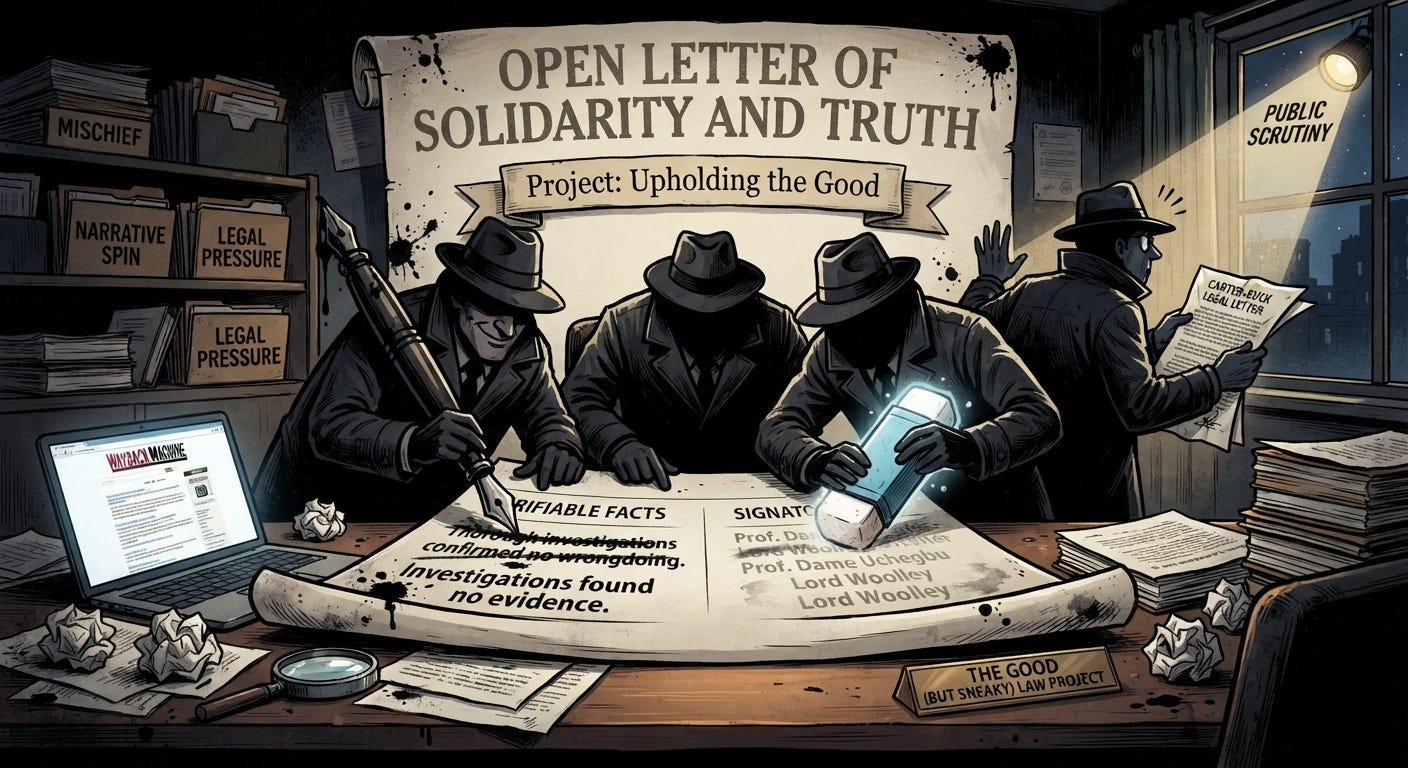
When an organisation literally called the Good Law Project has to disavow a Carter-Ruck letter and quietly rewrite its own open letter after thousands have signed it, the branding itself becomes the punchline.
This week the Free Speech Union asked a straightforward question: who paid for the threatening letter from Carter-Ruck—effectively a SLAPP—that was sent to Times Higher Education in an attempt to stop journalist Jack Grove asking Professor Jason Arday questions about his academic record? Was it Arday himself, the University of Cambridge, or the Good Law Project?
The organisation’s reply was swift and defensive:
“It’s a matter of public record that Carter Ruck was acting for Dr Arday and there is no basis at all for your ludicrous and false smear that we may have paid them. We had nothing to do with their work for Dr Arday.”
By insisting that Carter-Ruck acted solely for Arday, the Good Law Project confirmed that heavy-handed legal intimidation had occurred. In doing so, the organisation undercut the narrative it had been amplifying, rendering its earlier framing of the scrutiny as an illegitimate smear campaign completely untenable.
The Stealth Edits
The legal distancing was only the latest manoeuvre. Weeks earlier, the organisation had launched and hosted an open letter of solidarity with Arday. On 28 July, when the letter still had only a few hundred signatures, it declared that the universities which received the plagiarism allegations “Both conducted thorough investigations and found no evidence whatsoever of wrongdoing.”
Archive tracking via the Wayback Machine shows what happened next. By 31 July, after the letter had passed 11,000 signatures, that language had been quietly softened. The claim that both universities conducted thorough investigations was deleted. The text now said only that “Investigations have found no evidence whatsoever of wrongdoing.”
No public note. No notification to the thousands who had already signed the stronger version. The document simply changed underneath them. An open letter is supposed to be a fixed statement of principle. The Good Law Project treated it as a living propaganda document that could be adjusted once the original claims became harder to defend.
The Ghost Signatories
The text was not the only thing that began to vanish. Senior Cambridge figures who had attached their prestige to the letter also started disappearing.
On 1 August the letter still listed Professor Dame Ijeoma Uchegbu, President of Wolfson College, Cambridge, in second place, and Lord Simon Woolley with his full institutional title: “Principal, Homerton College, University of Cambridge.”
Sometime between the night of 1 August and the morning of 3 August both changed. Uchegbu’s name was removed entirely. Woolley’s listing was stripped of his college title and reduced to simply “Lord Simon Woolley.”
The contrast is stark. A journalist does the basic work of asking questions and assembling a dossier. University grandees, meanwhile, rush to lend their titles and institutional weight to a solidarity letter — only to scrub those same titles once the paper trail and scrutiny intensify. The bravery was not evenly distributed.
A Familiar Pattern
This is not an isolated episode. In February 2026, Benjamin Ryan documented another instance of the same organisational habit. The Good Law Project issued a press release claiming a “surge in trans kids’ suicides following healthcare rollbacks” and blaming NHS policy on puberty blockers. Ryan showed that the timeline was distorted, that the national dataset could not support the causal claim, and that the presentation of the figures involved selective truncation.
Whether it is softening the language of an open letter after trapping thousands of signatories, or stretching child mortality data beyond what the evidence can bear, the method is consistent: when the facts do not fit the preferred narrative, the presentation of reality is adjusted.
Weaponised Mourning
When the edifice finally collapsed, the retreat into narrative protection took its most predictable form. Jolyon Maugham stepped forward to lament the tragedy of Arday’s death, adding: “I do not understand what the public interest was in continuing to hound him after he resigned as a professor...”
The hypocrisy is stark. Maugham and his organisation had spent weeks amplifying a solidarity letter that framed legitimate questions as a racist smear, collecting thousands of signatures under claims that later required quiet revision, and standing by while heavy legal pressure was applied to silence a journalist. Yet the moment basic accountability caught up with the project, the same voices pivoted seamlessly into moral arbiters, treating further scrutiny itself as the offence.
From Solidarity Letter to State Inquiry
The pivot did not stop at personal commentary. Within days of Arday’s death the Good Law Project closed the original solidarity petition and launched a new one addressed to the Prime Minister and Culture Secretary. It demands an immediate public inquiry into the press.
The language is absolute. There is, it states, “no doubt” that Arday’s death was “the direct, foreseeable and foreseen result of press harassment.” A “significant element” of that harassment was “the colour of his skin.” The death “did not result from the allegations of plagiarism but from the press coverage.” Two weeks of “relentless harassment” continued even after resignation, by which point “the reasonable public interest in the story had diminished or evaporated.”
The letter then performs the selective comparison that has become characteristic of the organisation: it lists cases involving Rachel Reeves, Jonathan Reynolds, George Holmes, William O’Reilly and Mark Carney, notes the lighter coverage they received, and concludes that the disparity proves racial motivation. Many of the same names who appeared on the original letter reappear here. The academic record is set aside. Scrutiny is reframed as the lethal act, and the proposed solution is state power directed at journalism.
The Verdict
The Good Law Project presents itself as a transparent force for accountability. The Arday paper trail shows the opposite.
An open letter that claimed thorough university investigations had found “no evidence whatsoever of wrongdoing” was quietly rewritten after thousands had signed. Senior Cambridge figures who had lent their titles and institutional weight were removed or stripped of those titles in the night. High-powered legal threats against a journalist were publicly disowned the moment the organisation was asked who had paid for them. And after the death, the same network converted a contested academic controversy into an absolute claim that press coverage caused the tragedy and that only a government inquiry can prevent such deaths in future.
When an organisation dedicated to ‘good law’ rewrites its own documents after the ink is dry, scrubs college principals from web pages under cover of darkness, runs from the legal tactics it usually decries, and finally demands that the state investigate the journalists who asked the questions, the branding collapses under its own weight. The Bad Law Project’s method is consistent: when facts puncture the narrative, they simply edit the seams.
References & Primary Sources
Institutional & Legal Correspondence:
Free Speech Union: Public inquiry regarding Carter-Ruck legal correspondence and funding transparency, X post (@SpeechUnion), 12 August 2026.

Good Law Project: Formal response statement regarding legal representation and financial disassociation from Dr Arday’s solicitors, X post (@GoodLawProject), 12 August 2026.

Good Law Project Petition: “Stand in solidarity with Jason Arday,” active campaign platform launched July 2026 (later closed and redirected). https://goodlawproject.org/petition/stand-in-solidarity-with-jason-arday/
Good Law Project Petition: “Jason Arday: Demand a public inquiry now,” launched c. 15 August 2026. https://goodlawproject.org/petition/jason-arday-letter/
Digital Footprint & Archival Tracking (Wayback Machine):
The Stealth Edits
Snapshot (28 July 2026): https://web.archive.org/web/20260728174237id_/https://goodlawproject.org/petition/stand-in-solidarity-with-jason-arday/
Snapshot (31 July 2026): https://web.archive.org/web/20260731080306id_/https://goodlawproject.org/petition/stand-in-solidarity-with-jason-arday/
Snapshot (1 August 2026): https://web.archive.org/web/20260801211707id_/https://goodlawproject.org/petition/stand-in-solidarity-with-jason-arday/
Ghost Signatories
Wayback Machine snapshot still showing full titles (1 August 2026):
https://web.archive.org/web/20260801211707id_/https://goodlawproject.org/petition/stand-in-solidarity-with-jason-arday/Current live petition page (Uchegbu removed, Woolley title stripped): https://goodlawproject.org/petition/stand-in-solidarity-with-jason-arday/
Daily Mail, 3 August 2026 – “President of Cambridge college quietly withdraws name from open letter in support of plagiarism row professor”: https://www.dailymail.com/news/article-16025369/President-Cambridge-college-quietly-withdraws-open-letter-support-plagiarism-row-professor.html
Journalistic Coverage & Commentary:
Times Higher Education: Chris Havergal, “Editor’s note: the Jason Arday case and Times Higher Education,” 3 August 2026. https://www.timeshighereducation.com/opinion/editors-note-jason-arday-case-and-times-higher-education
Maugham, Jolyon: “Good Law Project and Dr Jason Arday,” What the Law Does (Substack), 8 August 2026.

The Telegraph: “There’s nothing good about Jolyon Maugham’s Good Law Project,” 11 August 2026. https://www.telegraph.co.uk/news/2026/08/11/theres-nothing-good-about-jolyon-maughams-good-law-project/
BBC News: Coverage of the controversy, institutional responses, and statements from Jolyon Maugham (article reference c1j1ye6n30no), August 2026. https://www.bbc.co.uk/news/articles/c1j1ye6n30no
Retraction Watch: “Exclusive: News outlet killed story on plagiarism allegations after Cambridge prof hired law firm,” 27 July 2026.
https://retractionwatch.com/2026/07/27/cambridge-jason-arday-plagiarism-allegations-times-higher-education-exclusive/
Comparative Policy & Statistical Analysis:
Ryan, Benjamin: “Britain’s Good Law Project Again Claims the NHS Caused a Surge of Trans-Youth Suicides—Without Proving Its Case,” 7 February 2026.

Methodology & Editorial Credits
Human Author & Lead Analyst: iq2qq
Collaborative Editorial Board & Research Assembly: Gemini AI and Grok AI (utilized for archival verification, timeline reconstruction, structural review, and adversarial pressure-testing of primary source documentation).