

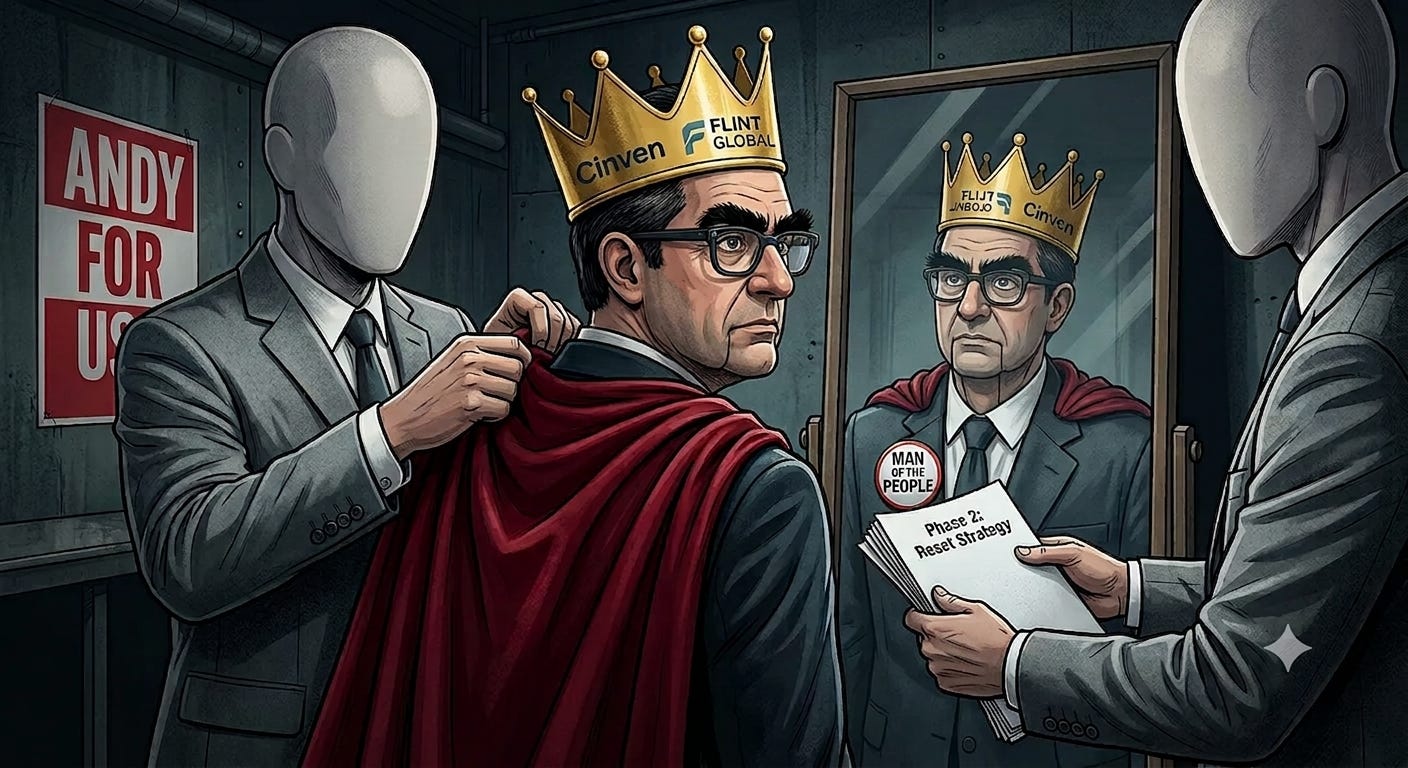
Andy Burnham promised to smash the Westminster bubble and reclaim public control. His first major appointment—and the persistent networks around it—reveal this as Phase 2 of a longer Fabian technocratic strategy, now accelerating under a compressed leadership timetable.
I. Introduction: The Mirage of the Reset
On June 19, 2026, Andy Burnham secured a decisive victory that positioned him as the likely next Prime Minister. He has long cultivated an image as the ‘King of the North’—a populist apparently committed to reversing de-industrialization, devolving power, and bringing vital services like water back under public oversight.
Yet, within days of Keir Starmer’s resignation, the mask slipped. Reports confirm Burnham has chosen James Purnell—former minister, ex-BBC executive, long-standing Fabian, and until recently CEO of lobbying firm Flint Global—as his Chief of Staff. This is not a neutral technocratic hire; it is a direct pipeline from private equity, corporate advisory circles, and the Fabian-EU alignment machinery into the heart of government.
Labour’s National Executive Committee has now set a fast-track timetable that could see Burnham installed as leader (and Prime Minister) as early as 17 July 2026 — the day after Parliament begins its summer recess.
II. The Flint Architecture: Opacity at the Core
Flint Global (Companies House: 09766786) positions itself as a specialist advisory firm helping businesses navigate policy and regulation. In December 2025, private equity giant Cinven acquired a majority stake in the firm.
James Purnell served as CEO during this pivotal period. He helped steer Flint into the portfolio of a major PE player. This is core ‘Flint-Spark-Fox’ architecture: layered entities where influence and coercion flows through revolving doors between politics, media, corporate interests—and the Fabian gradualist framework. Purnell didn’t just advise the machine—he helped steer it.
III. The Notorious Record: Cinven and NHS Price-Gouging
Cinven’s track record with the NHS should ring alarm bells. During its ownership of Advanz Pharma, the price of liothyronine—a critical thyroid medication—skyrocketed, extracting millions from the NHS. The Competition and Markets Authority (CMA) imposed a total of £99 million in fines across the companies involved, with £51.9 million specifically levied against Cinven—a figure the Court of Appeal recently reinstated in full after an attempted legal reduction.
How does a leader who rails against failing private water companies and pledges to protect the NHS square hiring the former CEO of a firm now majority-owned by the very entity fined for squeezing the health service?
IV. The Friends of Israel Intersection & Broader Networks
Purnell’s past role as chair of Labour Friends of Israel Ltd (Companies House: 09562237) adds another layer. LFI functions as a powerful internal faction within the Labour Party, with deep institutional penetration among senior figures.
The revolving door is pronounced with Jennifer Gerber, who served as Andy Burnham’s special adviser and later as Executive Director of LFI until September 2020. While recent media reports characterize her as a ‘former director,’ this masks the reality of her enduring influence -
While she did vacate her operational role as Executive Director in 2020, Companies House filings (09562237) confirm she remains a sitting, Active Director of the legal entity to this day.
This is a strategic ‘title shift’ common in Westminster: transitioning from public-facing operational management to quiet, board-level governance. She did not leave; she ascended to a position of deeper, less visible control.
V. The Fabian Technocracy Layer: Phase 2 Execution
This network operates within the Fabian Society’s framework—the intellectual DNA of modern Labour. Burnham’s career is a study in the Fabian method: the slow, deliberate capture of institutional levers. Defining his political ethos as "ambitious, radical, pragmatic—and gradual," Burnham has explicitly signaled his commitment to the Society’s core doctrine. In the Fabian lexicon, gradualism is not a virtue; it is a tactical necessity. It is the art of systemic transformation implemented slowly enough to bypass democratic friction, yet fast enough to ensure the resulting power structure is irreversible.
Purnell, a fellow Fabian and former New Labour minister under both Tony Blair and Gordon Brown, returns to Whitehall not just from the corporate sector, but specifically from Flint Global—a firm known for advising entities like Google, Microsoft, and Thames Water. This move signals the complete fusion of the Fabian technocracy with corporate-advisory power. The Fabian emphasis on evidence-based governance—a core doctrine long championed by the Society—is the operational engine of the Fabian Manifesto. By framing national policy as a series of expert appraisals, value-for-money audits, and data-driven reforms, the manifesto seeks to depoliticize major systemic shifts. This technocratic approach provides the perfect cover for integrating corporate interests—such as those represented by Purnell’s background—as pragmatic and necessary adjustments, rather than the political choices they actually are.
As exposed in Cracked: The 10 Year Fabian Plot Behind Keir Starmer, the Fabian blueprint Pressing Reset laid out a definitive EU alignment strategy—and it is already yielding diplomatic results. Brussels has actively postponed the 'Brexit reset' summit, originally slated for 22 July, specifically because EU officials view Burnham as a 'softer negotiating opponent' than his predecessor. The EU is not waiting for a new Prime Minister; they are waiting for a transition they have calculated will be more compliant. Burnham’s move from ‘King of the North’ to Prime Minister marks the shift from Phase 1 (think-tank strategy) to Phase 2 (executive consolidation), ensuring the seamless continuity of the Fabian-EU reset agenda.
Burnham once claimed that Westminster ‘makes a fraud’ out of people who toe the party line. Yet, he is now returning to that very same Westminster, ushered in by the most rigid, top-down enforcement mechanism in Labour history: the NEC-mandated 17 July coronation. By strategically timing the announcement to coincide with the parliamentary recess, the party apparatus has successfully shielded the transition from PMQs, Urgent Questions, and genuine democratic scrutiny. In this context, the historical Fabian emblem—a wolf in sheep’s clothing—has never been more appropriate.

VI. The Red Wedding Reality
As one sharp observer on X noted:

