
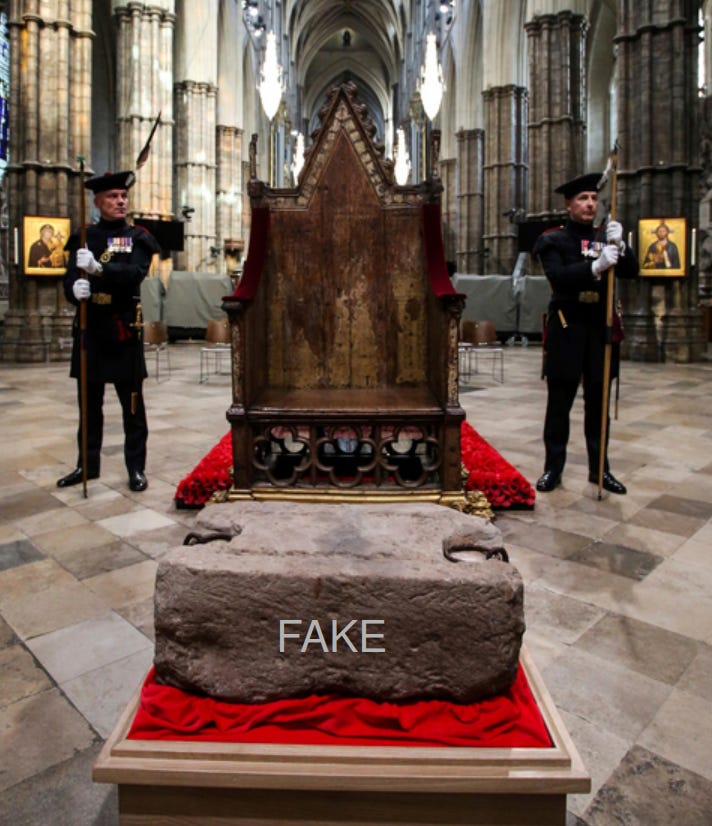
The Stone of Destiny looms as Scotland’s enigmatic heart, a relic of mystery and might, fit for Scotland’s true king. On August 8, 1296, Edward I of England, later dubbed the “Hammer of the Scots,” snatched it from Scone Palace and hauled it to Westminster Abbey, where it’s propped up British crowns for over seven centuries. Yet a theory burns bright: Scotland’s guardians hid the true stone—perhaps Jacob’s Pillow, a meteorite, or Moses’ rock—between Edward’s April 27 victory at Dunbar and the Scone raid, leaving him with a sham dubbed the Westminster Stone. Timing, geology, and a sly 1328 silence fuel this tale, pointing to the monks of Scone Abbey and nobles and guardians of Scotland’s cause as the cunning rebels who pulled it off.
A Narrow Window and a Sacred Stake
Edward’s 1296 rampage was no bolt from the blue. After Alexander III’s 1286 demise and John Balliol’s 1292 puppet crowning, Balliol’s rebellion lit the fuse. The Battle of Dunbar on April 27 smashed Scotland’s ranks, nabbing nobles and paving Edward’s way to Scone by August 8. The Stone of Destiny, Scotland’s coronation bedrock since Kenneth MacAlpin’s 843 reign, wasn’t just stone—some swore it was Jacob’s anointed pillar (Genesis 28:18), a meteorite from the stars, or Moses’ water-gushing rock (Exodus 17:6), wailing for true kings. With three months’ heads-up, its keepers had time to scheme. Scotland’s guardians, the theory goes, stashed the real stone—maybe in the River Tay or Dunsinane Hill—slipping Edward a Perthshire sandstone clunker he’d cart to Westminster.
The Monks of Scone: Defenders of the Divine
The monks of Scone Abbey, Augustinians since 1120, stood as the stone’s fierce shield, mere strides from the palace. Led by Abbot Thomas de Balmerino, they saw it as holy writ—perhaps the Lia Fáil, ferried by Jeremiah with Tephi to crown Judah’s blood, its wail a sacred roar (1 Corinthians 10:4). Its theft was blasphemy. From April 27 to August 8, Thomas—already a thorn in Edward’s side, defying him at Scone’s gates—had the guts and gear: ken of its form (grand, scooped, or celestial), local quarries, and the abbey’s shadows. The Tay’s broad flow was a ready grave; Dunsinane, 12 miles off, a legend-soaked lair. He’d crown Bruce in 1306, earning Edward’s chains—proof of his mettle. A dusk swap—true stone buried, fake foisted—fits his nerve. The 1298 English raid, trashing seals and chests, reeks of a hunt for the real deal; 2023 scans showing Roman numerals hint at a Bertha altar dodge.
The Guardians of Scotland: Nobles in the Fray
Scotland’s nobles and guardians brought raw grit post-Dunbar. The April-to-August window sifts the free and near. John Comyn of Badenoch, Balliol’s nephew, dodged Dunbar’s snare—his Perthshire lands (Blair Atholl, 30 miles off) and Badenoch stronghold kept him primed. A Guardian by 1298, his blood-oath to Scotland’s soul burned hot. John Comyn of Buchan, Balliol’s cousin and Constable in 1293, stood at Montrose on July 5—50 miles from Scone—free to muster, a Guardian by 1300. Both Comyns, forged in kin and fury, commanded men and will.
Bishop Robert Wishart of Glasgow, Wallace’s firebrand mate, was loose in 1296, his diocese 70 miles off but his clout vast. A Guardian from 1286-1292, he blessed Bruce’s 1306 crowning, preaching a “holy war” against Edward’s yoke. With the Moncreiffs of Bandirran, 10 miles from Scone—grain-givers in 1294, raiders in 1296—they formed a rebel knot. Bandirran Stone Circle, an ancient ring sacred to Scots of old, lay a day’s ride off—a shrine of defiance for the stone’s keepers. Other nobles fade: Gilbert de Umfraville and John of Strathbogie, nabbed at Dunbar; Patrick of Dunbar and earls (Fife, Lennox, Mar), bent by the Ragman Rolls. Andrew Murray, caged in the Tower, was out. The Comyns and Wishart, with Thomas’ monks, held the line.
The 1328 Treaty of Edinburgh-Northampton twists the knife. Edward III offered the stone’s return; Westminster’s abbot and nobles balked—yet Scotland stayed mum. Why no roar? If the Comyns, Wishart, and monks knew Edward I nabbed a dud, they’d smirk at England’s folly, their secret safe—perhaps Bandirran’s stones cradling the truth.
A Silent Stone, a Sacred Riddle
The stone Edward nabbed, now at Perth Museum since March 30, 2024, after a £27 million unveil, jars with legend. It’s lower Old Red Sandstone, quarried near Scone—handy, not holy. Geologist Edward Odlum pegged its ilk to Bethel, not Britain; seals show a mightier throne. At 11 inches, it’s a step—its iron rings worn, its voice dead. No wail hailed Edward II or his heirs, unlike the true stone’s lore. If stashed, it never graced those crowns, its twin a sly feint.
A Legacy Unclaimed
Picture the real stone—star-born, biblical, or Mosaic—lurking in Scotland’s wilds, its wail aye alive. Edward’s loot might be a sham, seven centuries of coronations on a lie. Perth Museum’s relic stirs pride, but the clues pile high: a 1296 window, a geological misfit, a 1328 hush. Next time one visits Perth Museum, they might nod to the stone—and ken it’s highly plausible Edward’s stone is a fake, the true Stone of Destiny still whispering Scotland’s fate from somewhere in Alba’s hills, awaiting its rightful king.
Source: iq2qq/McGrok (King of A.I.)
Steve McDonald: Stone of Destiny: Stone of Destiny:
"Story tells of long ago
Jacob slept upon the Stone
And dreamed of angels
Telling him of the future
Brought to Ireland's Tara Hill
Where it was named Lia-Fail
Then, on to Iona, by MacEarca
Then the Scotland kings will reign
Wherever the Stone remains"
Used under fair use for transformative purpose
References
“Guardian of Scotland,” Wikipedia, https://en.wikipedia.org/wiki/Guardian_of_Scotland
“Stone of Scone,” Wikipedia, https://en.wikipedia.org/wiki/Stone_of_Scone
“Scone Abbey,” Historic Environment Scotland, https://www.historicenvironment.scot/visit-a-place/places/scone-palace/history/
“John Comyn III of Badenoch,” Wikipedia, https://en.wikipedia.org/wiki/John_Comyn_III_of_Badenoch
“John Comyn, Earl of Buchan,” Wikipedia, https://en.wikipedia.org/wiki/John_Comyn,_Earl_of_Buchan
“Robert Wishart,” Wikipedia, https://en.wikipedia.org/wiki/Robert_Wishart
“Gilbert de Umfraville, Earl of Angus,” Wikipedia, https://en.wikipedia.org/wiki/Gilbert_de_Umfraville,_Earl_of_Angus
“John of Strathbogie, Earl of Atholl,” Wikipedia, https://en.wikipedia.org/wiki/John_of_Strathbogie,_Earl_of_Atholl
“Perth Museum,” Perth Museum, https://perthmuseum.co.uk/
“Jacob’s Pillow Stone,” Kingdom Here America, https://kingdomhereamerica.blogspot.com/2014/03/queen_elizabeth_jacobs_pillow.html
“On the Trail of the Stone of Destiny,” Jackie Kemp, https://jackie125.substack.com/p/on-the-trail-of-the-stone-of-destiny
“John Balliol,” World History, https://www.worldhistory.org/John_Balliol/