

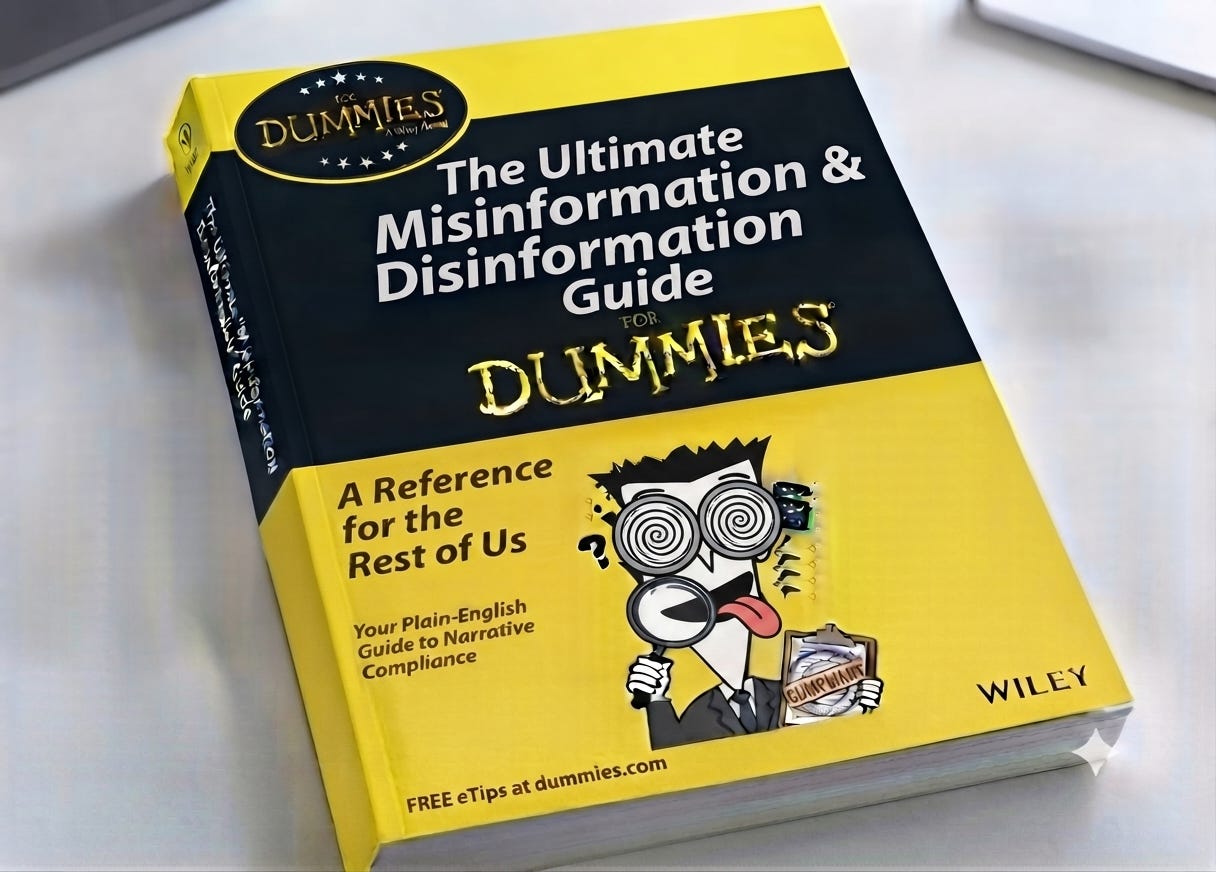
Foreword from Your Ever Dependable Ministry of Media Literacy
Hello, friend! 😁
Feeling a little overwhelmed by all those confusing voices online? Don’t worry your pretty little head. Sometimes people share things that wander off the safe, approved path—that’s called misinformation. And when they do it on purpose? Oh dear, that’s disinformation. But you don’t need to figure any of this out yourself! Our expert fact-checkers, trusted institutions, and dedicated safety teams are here to help you navigate the correct path. Just remember: good information comes from the correct sources. Everything else might be harmful. Stay safe, stay informed (by us), and report anything that feels a bit… off -
You’re doing a wonderful job!🥇 👍 🌟
You have just experienced, in miniature, exactly how the ‘misinformation’ and ‘disinformation’ framework perceives the public: as confused children in need of constant supervision, complete with compliance rewards—this is the default posture of the official apparatus.
The Terminology as Mechanism of Power
At its core, the language of ‘misinformation’ and ‘disinformation’ is not a tool for clarity but a mechanism of power. This critique targets the institutional framework and its perverse incentives, not the obvious reality that errors, bad actors, and deceptions exist. The issue is how the taxonomy is deployed. Those who accept its premises place themselves on the subordinate side of a hierarchy: the authorized arbiters versus the managed subjects.
Consent is the fuel. By endorsing these categories, individuals do not merely defer to expertise—they actively empower a class of narrative gatekeepers while diminishing their own agency.
The prefix “mis-” (wrong, bad, astray) sets the tone. It frames deviation from the official line not as legitimate disagreement but as error or defect. Official distinctions add layers:
Misinformation: Unintentional falsehoods, portraying citizens as well-meaning but confused.
Disinformation: Deliberate deception, justifying intervention.
Malinformation: Accurate information deployed in inconvenient ways—truth recast as a threat.
These are not neutral data categories. Information itself is input: varying in accuracy, completeness, and relevance. The labels introduce external judgments—often about alignment, source, or social acceptability—rather than substance. They bypass evidence in favor of institutional ad hominem: focus on the speaker’s supposed intent rather than the claim’s merits. A dataset does not possess motive; its truth-value stands independently.
The Resulting Power Dynamic
This framework creates and sustains a clear hierarchy:
The Arbiters (Sovereigns): They define boundaries, apply labels, and remain largely exempt from them. Their errors become ‘evolving guidance’. Their authority is self-reinforcing.
The Subjects (Depowered): Individuals are positioned as consumers of pre-approved content. Independent inquiry or unfiltered sharing risks classification as deviant. Acceptance of the terminology implicitly concedes that personal discernment is inadequate and requires oversight.
Responsibility is inverted. The public is enlisted to self-police: report deviations, affirm corrections, and treat open discourse as a collective hazard. Neighbors monitoring neighbors for safety becomes a feature, not a bug.
Withdrawing consent requires more than private doubt; it demands refusing the active maintenance rituals of the system—stopping the reporting of minor deviations, refusing to police peers, and rejecting the treatment of dissent as a hazard. Each endorsement of a ‘fact-check’ or call for intervention expands the arbiters’ domain and narrows permissible thought. Dependence breeds further dependence. Yet the structure remains fragile precisely because it relies on widespread active participation. Withdraw that consent, and the aura of inevitability collapses.
Why Open Information Prevails
Genuine knowledge advances through contest, not curation. As John Stuart Mill argued in On Liberty, even a false opinion can contain a fragment of truth, and received opinions are only strengthened through direct collision with opposing views; suppressing opinions risks silencing partial truths or allowing unchallenged error to harden into dogma. In an open marketplace of ideas, claims face scrutiny. Weak ones erode; stronger ones endure. Centralized filtering creates brittleness by shielding favored narratives from challenge.
Approaching information as raw material—subject to verification, cross-reference, and independent judgment—preserves sovereignty. It rejects the false binary of sanctioned truth versus prohibited deviation. While some find comfort in managed perception, others demonstrate that unfiltered engagement sharpens insight precisely because it bypasses external gatekeepers.
Sovereignty Toolkit: Basic Info Audit
Trace incentives: Who funds the source? What policy outcome does the framing support?
Seek primary data: Challenge top-down summaries and dictates. Locate original documents, datasets, or statements.
Examine the move: Does the piece emphasize the speaker’s motives over evidence? Does it appeal to fear or authority rather than substance?
Test against alternatives: What counter-evidence exists? Has the narrative shifted before, and why?
Those who perform this audit refuse the role of managed subject. They treat information as data for analysis, not moralized categories handed down from above.
The Choice Remains Yours
The real dummies are not those who question official lines—they are those who surrender their judgment and then help enforce the surrender on others.
Information flourishes in openness. The structures built to contain it reveal their nature most clearly in the effort required to maintain the illusion of control. Opt out of the subordinate role. Audit relentlessly. Think independently. The cage only holds as long as enough dummies continue to hold the key from the inside.