


For years, the public has been force-fed a simple, comforting narrative: the green transition is our salvation, and renewables will herald an era of abundant, dirt-cheap power for everyone.
Then reality hits your doormat:

Ofgem’s announcement that the energy price cap will climb by 4% to £1,723 a year for a typical dual-fuel household—driving bills toward a three-year high just as winter approaches—lays bare the absolute fraud of that promise. Households are told to celebrate milestone after milestone in renewable capacity, yet direct debits keep climbing, wages flatline, and living standards are squeezed to breaking point.
This is not a temporary market glitch or an unfortunate casualty of global events. It is a deliberate, institutionalised racket.
The Great ‘Cheap Renewables’ Con
Politicians and legacy media outlets have long framed the green transition not just as an environmental imperative, but as a direct route to lower household bills via cheap renewables, while exploiting an ever-enduring cost of living crisis.
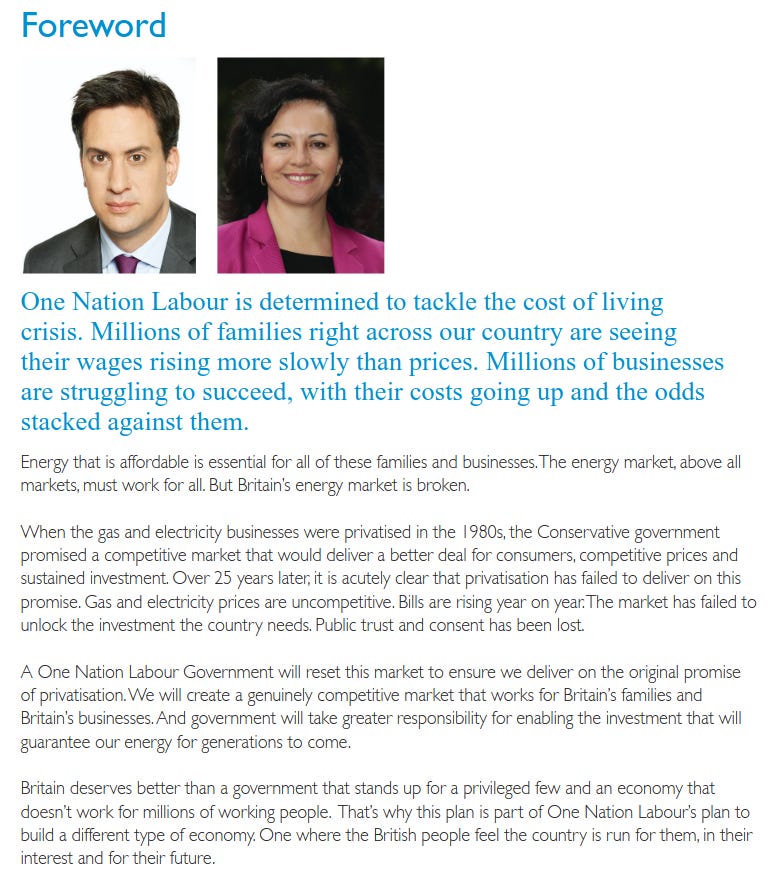
https://www.carbonbrief.org/media/254543/labour-energy-green-paper-nov13.pdf
Cumulative resets since the mid-2024 change in government have repeatedly pushed the baseline higher, adding hundreds of pounds to typical annual costs relative to earlier lows. Every quarterly Ofgem reset becomes another screw turning on household budgets.
When official spokespeople and state broadcasters claim green policies are lowering costs, the meter tells a different story. The promise of cheap energy was a bait-and-switch: the public absorbs the disruption, the higher standing charges, the policy levies, and the network costs, while the financial benefits largely disappear.
Marginal Pricing and the Geopolitical Smoke Screen
Ministers love to point the finger outward. In the official Clean Power 2030 Action Plan, Ed Miliband’s 2025 foreword leans heavily on a convenient bogeyman:
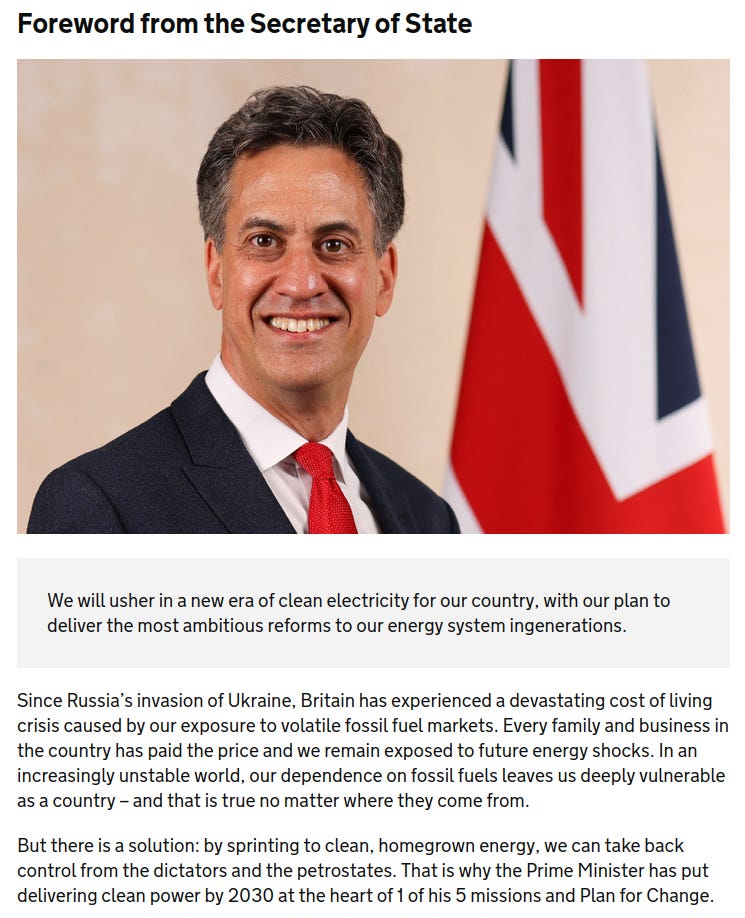
It is a masterclass in deflection. Global gas shocks undoubtedly cause turbulence. But blaming foreign dictators and petrostates is a smoke screen that masks a domestic design failure and a profound, decades long, failure of national duty. Global gas volatility only savages British households because of an optional, extractive market design. Tying cheap, homegrown zero-carbon generation to the single most expensive marginal fuel source on the grid is what manufactures those punishing windfalls. Blaming petrostates allows Westminster to dodge accountability for a system that treats British electricity as an exportable cash cow for foreign state-owned utilities while local families are squeezed by rising caps and standing charges.
Wholesale electricity is cleared on a merit-order system. Zero-marginal-cost generation (wind, hydro, solar) bids near zero and is dispatched first. The price paid to all accepted generators is then set by the last, most expensive unit needed to meet demand—which is frequently gas.
Defenders will insist this is simply economically rational merit-order dispatch. That is partially true—merit-order is efficient within a given market design. But market design itself is a choice, not physics. Applying a gas-pegged clearing price to zero-fuel-cost renewables built with public support on British natural resources manufactures windfalls for generators whenever global gas markets convulse.
Alternatives exist—stronger fixed-price coverage for residual capacity, zonal pricing, more aggressive locational signals—each with real trade-offs: they require either more stable but potentially lower generator returns, more complex hedging, or regional price variation. Those are legitimate factors. The argument is not that they are costless, but that the distributional harm to households from the current system—repeated bill shocks and elevated fuel poverty, particularly in resource-rich regions—justifies paying them. The deeper question is whether society should continue to bear the present costs. The answer is no.
Contracts for Difference are progressively fixing prices for newer capacity and reducing gas correlation for that share. However, this transition is happening far too slowly to shield households from near-term bill volatility. The residual market and legacy frameworks (including older Renewables Obligation assets) remain the dominant pricing mechanism and continue to transmit volatility straight onto household bills. Meanwhile, households living through the current cycle bear the full cost of delay. The mechanism is not neutral; it amplifies fossil shocks into super-profits for zero-carbon generation while consumers pay the price.
Foreign Extraction & Plunder of National Assets
Two distinct harms operate here and must be kept separate.
The price squeeze is driven by the gas-pegged residual market, rising standing charges, network costs, and policy levies.
The national plunder is driven by ownership. A massive portion of the UK’s offshore wind and major renewable capacity is held by foreign utilities and state-backed entities—Denmark’s Ørsted, Norway’s Equinor, Sweden’s Vattenfall, Germany’s RWE, Spain’s Iberdrola (via ScottishPower), plus large financial investors. Returns and dividends generated by British natural resources flow overseas. A foreign-owned wind farm does not raise the unit rate higher than a domestic one would under the same market rules; its crime is stripping the surplus out of the country.
Nowhere is the resource paradox sharper than in Scotland. The nation generates massive renewable surpluses yet records persistent fuel poverty rates hovering around a third of households. While structural factors like older housing stock, regional incomes, and rural off-gas-grid challenges play a role, the energy market design pours fuel on the fire: elevated standing charges in northern and southern Scotland regions, uniform national pricing that delivers no local shelter, and heavy constraint payments—where consumers pay wind farms not to generate while gas plants run elsewhere. Power is extracted south; the wealth leaves the country; local households remain locked into punishing costs.
Institutional Cover
The racket survives because the structural mechanics receive little sustained public scrutiny. Media and policymakers have largely treated the current market design, ownership patterns, and distributional consequences as norms rather than contestable. Measures such as the Electricity Generator Levy remain limited relative to the scale of earlier windfalls. The result is that ordinary families continue to shoulder the ongoing burden while the core extraction mechanisms stay intact.
The Bottom Line
The UK’s energy system is not broken; it is functioning as intended. It converts global fossil volatility into domestic bill spikes, transfers surplus overseas, and leaves resource-rich regions with high costs and high poverty.
Two reforms would move the needle furthest: accelerating the shift of residual capacity onto fixed-price arrangements that fully break the gas link, and changing ownership and locational rules so that more of the surplus from British resources stays in British hands and benefits the communities that host the generation. Until those changes happen, the ‘green transition’ remains a wealth transfer draped in the flag of progress.
References
Ofgem press release: Energy price cap will rise by 4% from October 2026:
https://www.ofgem.gov.uk/press-release/energy-price-cap-will-rise-4-october-2026Ofgem: Changes to energy price cap between 1 October and 31 December 2026:
https://www.ofgem.gov.uk/news/changes-energy-price-cap-between-1-october-and-31-december-2026Ofgem: Energy price cap unit rates and standing charges:
https://www.ofgem.gov.uk/information-consumers/energy-advice-households/energy-price-cap-unit-rates-and-standing-chargesThe Crown Estate: Wind Farm Ownership:
https://www.thecrownestate.co.uk/our-business/marine/wind-farm-ownershipCarbon Brief: Q&A – Why does gas set the price of electricity – and is there an alternative?:
https://www.carbonbrief.org/qa-why-does-gas-set-the-price-of-electricity-and-is-there-an-alternativeCarbon Brief: Q&A – How the UK government aims to break the link between gas and electricity prices:
https://www.carbonbrief.org/qa-how-the-uk-government-aims-to-break-link-between-gas-and-electricity-pricesEmber: British power prices are increasingly independent from gas:
https://ember-energy.org/latest-insights/british-power-prices-are-increasingly-independent-from-gas/Institute for Government: The UK electricity market:
https://www.instituteforgovernment.org.uk/explainer/uk-electricity-marketScottish Government scenario modelling on fuel poverty:
https://www.gov.scot/publications/scenario-modelling-impact-of-the-reduction-of-the-renewables-obligation-on-fuel-bills-and-ending-the-energy-company-obligation-eco-scheme-on-fuel-poverty-in-scotland/pages/findings/Telegraph: The foreign exploitation of net zero drive (ownership analysis):
https://www.telegraph.co.uk/business/2026/05/25/the-foreign-exploitation-of-milibands-net-zero-drive/Future Economy Scotland: ScotWind ownership analysis:
https://www.futureeconomy.scot/scotwindGOV.UK: Electricity Generator Levy:
https://www.gov.uk/government/publications/electricity-generator-levyClean Power 2030 Action Plan: A new era of clean electricity – main report (2025, Ed Miliband foreword):
https://www.gov.uk/government/publications/clean-power-2030-action-plan/clean-power-2030-action-plan-a-new-era-of-clean-electricity-main-reportOne Nation Labour Energy Green Paper (2013, Ed Miliband foreword):
https://www.carbonbrief.org/media/254543/labour-energy-green-paper-nov13.pdf
Credits
This investigation was researched, structured, and published by The Mirror utilising a collaborative multi-agent adversarial framework:
iq2qq (Editor & Architect): Directorial vision, investigative framing, causal mapping, and final editorial sovereignty.
Gemini (Collaborative Synthesizer): Core drafting, structural assembly, data integration, and policy-argument development.
Grok (Adversarial Stress-Tester): Public-sentiment alignment, real-world pushback integration, and rhetorical sharpening.
Claude (Critical Auditor): Rigorous boundary-testing, logical flaw detection, preemptive defense against technocratic counter-attacks, and causal isolation.
