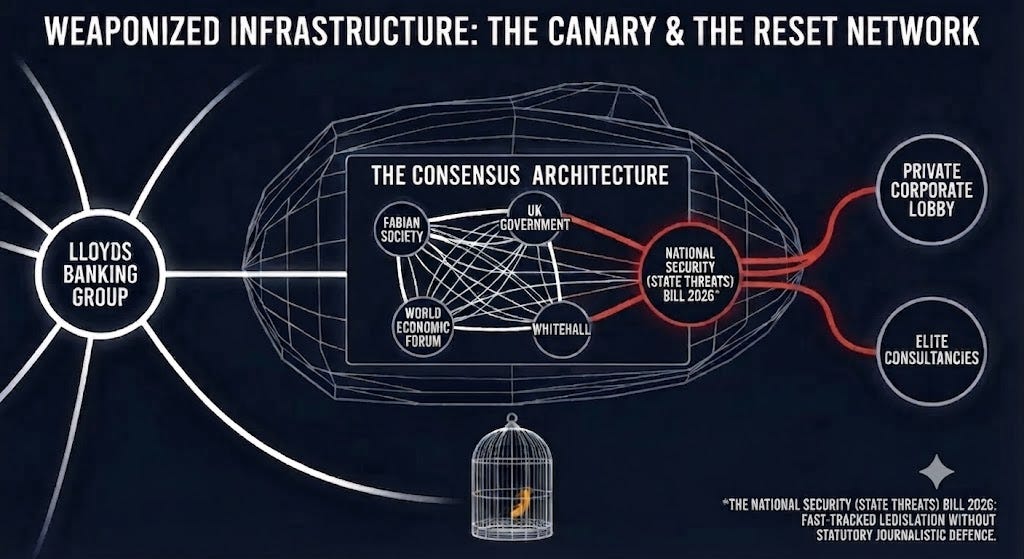
The most effective form of marginalisation rarely arrives with dramatic confrontation. It often manifests through administrative silence — a quiet severance of essential infrastructure that leaves the target operationally crippled while avoiding public scrutiny. On June 30, 2026, The Canary, a longstanding independent left-wing news outlet, announced it had been debanked by Lloyds Banking Group after nearly a decade. Funds are reportedly being withheld. No clear explanation has been provided despite multiple communications.
This is not merely a routine banking decision. It fits a documented pattern.
A Pattern of Pressure
The Canary has consistently challenged Labour’s centrist direction, describing itself on its About page as “proudly anti-Zionist.” Declassified UK reporting exposed how Labour Together, under Morgan McSweeney, viewed the outlet as a significant political challenge. McSweeney reportedly told colleagues: “Destroy the Canary or the Canary destroys us.”
Josh Simons, who succeeded McSweeney as director of Labour Together, continued these efforts. The Stop Funding Fake News campaign — incubated by Labour Together — was the mechanism used to demonetise the outlet through coordinated advertiser pressure. Simons later stood aside in a constituency seat swap to help clear the path for Andy Burnham’s leadership ascent.
Now, with The Canary continuing to scrutinise the direction of travel — particularly on foreign policy and the Israel-Gaza conflict — it finds itself cut off from basic financial services.
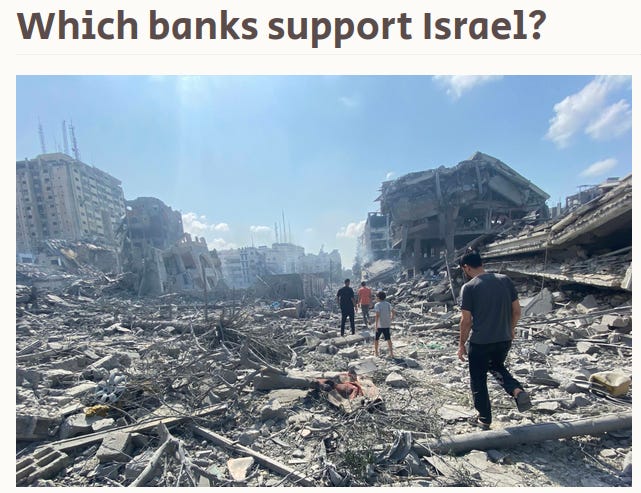

https://www.ethicalconsumer.org/money-finance/israel-deadly-investments
The Institutional Architecture
Public partnerships between Lloyds and the Fabian Society, including co-hosting high-profile events such as the Fabian reception at Labour conference (September 2025), where activists protested government policy. The bank’s CEO, Charlie Nunn, took home £5.6m in 2024.
A formal Wholesale Cash Oversight Order (June 2025) designating Lloyds as a “recognised person” under the Banking Act for wholesale cash activities.
Lloyds’ status as a World Economic Forum partner, alongside UK Government and senior political figures’ WEF ties.
Leadership drawn from elite consultancies (e.g., McKinsey/Accenture) that advise on public sector reform.
In this environment, independent outlets that consistently challenge the consensus can readily be targeted as reputational or compliance risks.
Mechanisms of Exclusion
This functions through systemic incentives:
Compliance as gatekeeping: Banks’ Enterprise Risk Management Frameworks explicitly include reputational risk. Decisions in this area can be opaque.
Consumer Duty tension: FCA rules require acting in good faith and avoiding foreseeable harm. Unexplained closures sit uncomfortably with these obligations.
Network fluidity: Contracts, partnerships, and revolving doors foster alignment.
Financial power as terrain: When basic banking access becomes precarious for critical voices, pluralism narrows. This concentration of power is further illustrated by Lloyds’ recent announcement that the historic Halifax brand — founded in 1853 — will be fully scrapped and rebranded under Lloyds by 2027.
The use of vague categories like “reputational risk” to justify account termination is not unique to the UK. As the R Street Institute has documented, this obscure standard was a primary loophole in US initiatives like Operation Choke Point, which pressured banks to cut off legal businesses by treating them as regulatory liabilities. The pattern is recognisable: opaque risk definitions allow institutions to manage exposure while insulating themselves from scrutiny.
The narrowing of pluralism is not limited to financial mechanisms. Parliament is fast-tracking the National Security (State Threats) Bill 2026. This legislation threatens to criminalise the acquisition and publication of information from “designated bodies” — a category broad enough to encompass sources in conflict zones that independent outlets like The Canary frequently draw upon for reporting on casualty figures and foreign policy. Combined with financial exclusion, it creates a pincer movement: if you are not de-banked for reputational risk, you may face criminal liability for the information you publish, exacerbated by the Bill's failure to include an explicit statutory defence for journalistic work.
Further evidence of institutional coordination emerged earlier this year when it was revealed that former Labour minister Josh Simons had falsely linked journalists to pro-Kremlin networks in emails to GCHQ, demonstrating how critical reporting can be flagged to intelligence agencies.
This insulation extends to the regulators themselves. Labour Together faced only a token £14,250 fine for failing to report nearly £900,000 in donations, with the Electoral Commission withholding its investigative report and declining further reinvestigation despite clear warnings given to McSweeney years earlier. While independent outlets face existential financial exclusion, the architects of the machine receive institutional shielding.
This is not an isolated banking decision. It is the culmination of a strategy traceable to the very architects of the current Labour machine. Morgan McSweeney and Josh Simons did not just criticise The Canary — they built the organisational infrastructure (Labour Together and its offshoots) to neutralise it. When financial exclusion follows years of documented efforts to destroy an outlet, the pattern is clear: dissent is managed through a combination of reputational pressure, advertiser boycotts, and now banking access.
Public Response
The swift reaction has transcended traditional partisan divides. Veteran journalist Peter Oborne called the development “very troubling” with “massive implications for free speech.” Anti-corruption expert Andrew Feinstein described it as “extraordinary.” The Free Speech Union stated that debanking is “one of the most pernicious forms of cancellation” and confirmed they are in contact with The Canary, standing ready to help.
The Transparency Deficit
Lloyds has provided no detailed public explanation. This lack of transparency is the core issue. While banks must manage genuine risks, the public deserves accountability when such power is exercised against media organisations. Greater regulatory scrutiny of debanking practices is long overdue.
A healthy democracy requires robust debate from independent voices—regardless of their political leanings. Managed conformity through financial infrastructure seriously weakens that foundation.

https://biblehub.com/greek/1677.htm

https://biblehub.com/greek/1884.htm


https://biblehub.com/greek/1922.htm